

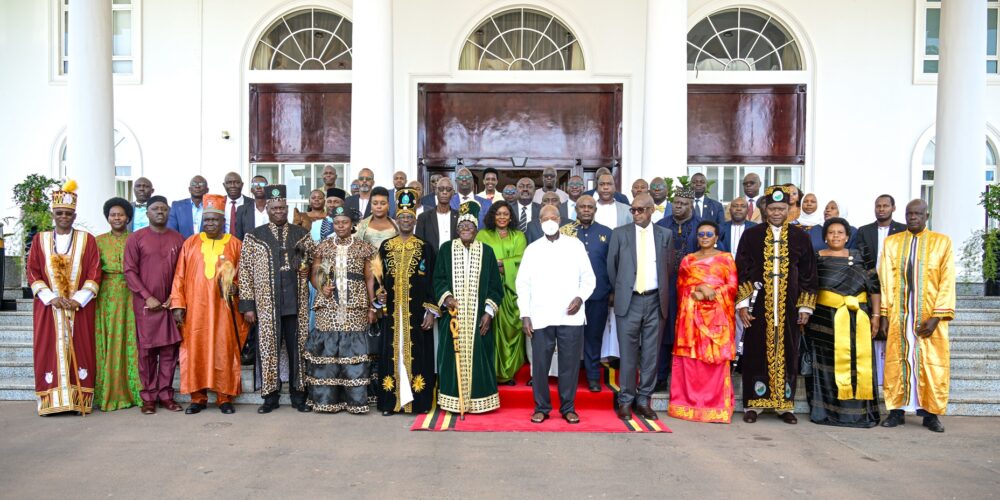
President Yoweri Kaguta Museveni has called on traditional and cultural leaders to play a greater role in preserving Africa’s heritage, promoting indigenous knowledge and supporting wealth creation as part of Uganda’s national development agenda.
The President made the call while addressing cultural leaders on the first day of a two-day conference at State House, Entebbe, where he emphasised the need for cultural institutions to promote African identity, unity and economic transformation.
He said cultural institutions should focus on preserving indigenous languages, traditions, historical knowledge and traditional skills, many of which were undermined by colonialism, while complementing government efforts rather than competing with elected institutions.
President Museveni identified traditional expertise in agriculture, livestock keeping, fishing, blacksmithing, carpentry, pottery and other crafts as valuable resources that should be documented and passed on to younger generations. He also urged cultural leaders to promote indigenous crops and livestock breeds to strengthen food security and household incomes.
On continental development, the President said Africa must move beyond political independence to economic independence through production, expanded markets and regional integration. He highlighted the East African Community (EAC), COMESA and the African Continental Free Trade Area (AfCFTA) as key frameworks for boosting trade and economic cooperation.
He further called for deeper East African integration, arguing that shared history, cultural connections and common economic interests provide a basis for stronger regional cooperation.
In response, cultural leaders proposed partnerships with government in agriculture, industrialisation, tourism, cultural preservation, women economic empowerment and skills development.
They offered to provide land for model agricultural farms to serve as training and innovation centres, but appealed for government support in the form of improved seeds, livestock, irrigation facilities, machinery and agricultural expertise.
The cultural leaders also proposed establishing community-based production facilities for agro-processing, textiles, crafts, leather products and other value-added enterprises.
To promote cultural preservation and tourism, the leaders called for the establishment of a Digital Cultural Park showcasing Uganda’s kingdoms, historical sites, traditional leadership systems, artefacts, music, dance and indigenous knowledge. They also announced plans to organise a Uganda National Cultural Festival in partnership with the Ministry of Gender, Labour and Social Development.
The cultural institutions further called for a structured framework of engagement with government, regular dialogue and support to strengthen their coordination and operational capacity.
The Minister of Gender Labour and Social Development, Gen Henry Tumukunde, urged cultural leaders to work with government in addressing social challenges, including gender-based violence, child marriage, teenage pregnancy, poverty, unemployment and discrimination against persons with disabilities.
He also highlighted the economic opportunities in Uganda’s creative and cultural industries, commonly known as the Orange Economy, which includes music, film, fashion, crafts, performing arts, publishing and cultural tourism.
The two-day conference brings together cultural leaders from across Uganda to discuss heritage preservation, indigenous knowledge, community development and the contribution of traditional institutions to national transformation.