

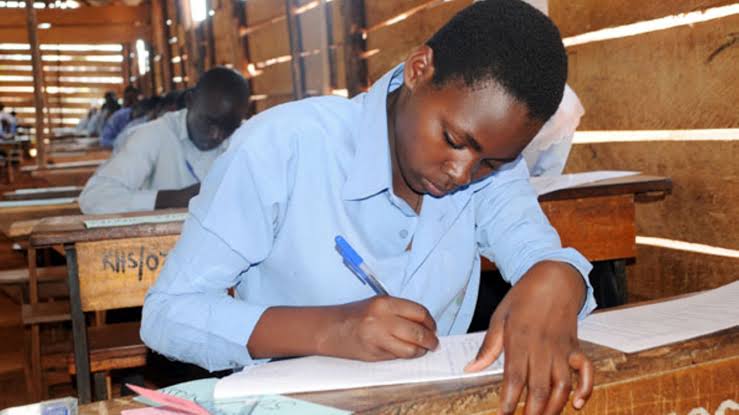
As the morning bell rang today, Monday, November 9, 2026, a staggering 203,809 candidates walked into examination rooms across Uganda to write their first UACE papers.
While the country will rightfully celebrate this massive 22.4% spike in A-level candidates from last year, a much deeper problem hangs over our desks.
We are celebrating a statistical boom while completely ignoring a massive educational bottleneck.
This year’s Senior Six candidates are a historic group of guinea pigs.
They are the pioneer cohort who completed their lower secondary education entirely under the new Competency Based Curriculum (CBC) in 2024. They were trained to think creatively, evaluate the real world scenarios, and move away from pure memorization.
Yet, for the past two years, they have been crammed into a traditional A-Level system that has not yet been fully overhauled by the National Curriculum Development Centre (NCDC).
To bridge this gap, the UgandaNational Examinations Board (UNEB) rushed out “aligned” sample papers a few months ago. These papers introduce sudden “scenario-based tasks” to old subjects like analyzing complex business cases in Entrepreneurship or interpreting world events in History instead of just repeating facts.
We are asking teenagers to solve real world problems on paper, but we haven’t given most schools the basic infrastructure to teach those practical skills.
As UNEB Executive Director Dan Odongo openly acknowledged, a critical challenge in this shift is that rural and private schools simply lack well equipped science laboratories and workshops.
Odongo stated that because the new curriculum is skills based, it fundamentally requires well equipped science labs and workshops so learners can engage in self-learning. He explicitly noted that “unfortunately, many rural and private schools lack these.”
How can students be tested on real world competencies when they are still learning chemistry from a blackboard?
Additionally, our collective mindset is still trapped in the old way of thinking.
Speaking to the press ahead of the examinations Timothy Ssejjoba, the Commissioner for Higher Education at the Ministry of Education and Sports in Uganda, spoke out strongly against examination malpractice and the hyper focus on grades over practical skills.
He noted that it would be a “disservice to the country if institutions of higher learning admitted students whose good grades had been obtained through examination malpractice and urged a shift in focus from mere marks to actual demonstrable skills,”
But can we blame the schools, parents, or students for being obsessed with grades? Until our universities reform their entry requirements to reward real skills instead of a perfect score on a paper, students will continue to cram, schools will continue to drill, and the system will remain broken.
The 2026 UACE exams shouldn’t just be celebrated for their high turnout; they should serve as a loud wake up call that you cannot build a modern, skill based economy on top of a crumbling, grade obsessed foundation.