

The Uganda Bureau of Statistics (UBOS), in collaboration with the Ministry of Education and Sports, is conducting an accelerated rollout of the Baseline Education Census 2025 in seven sub-regions in Uganda.
This comprehensive data gathering initiative, aimed at mapping the country’s educational landscape, targeting remote and underserved regions to ensure no school is left behind in Uganda’s push for equitable education under Vision 2040.
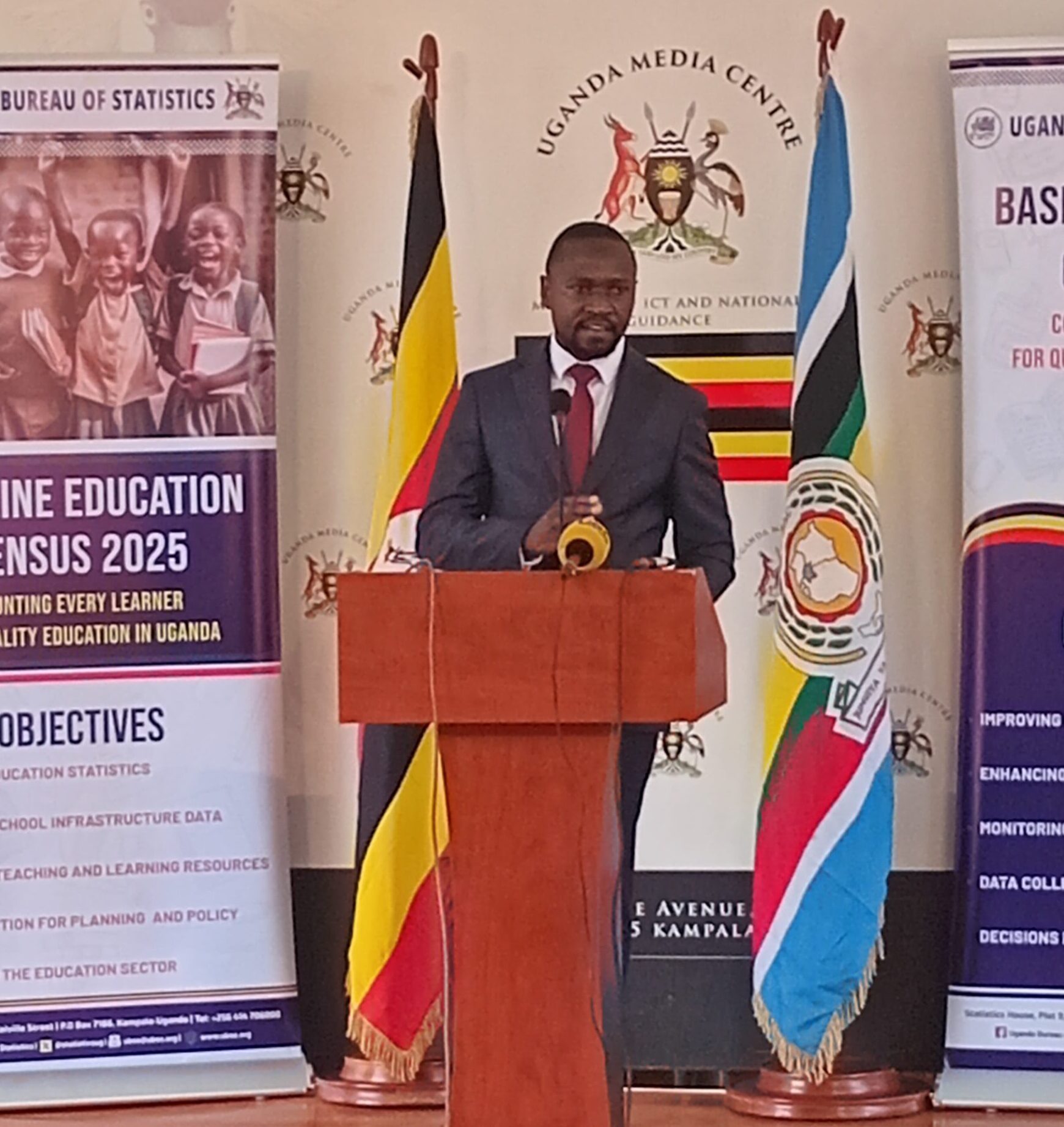
While addressing journalists at the Uganda Media Centre on October 27, 2025, Didacus Okoth, UBOS Principal Public Relations Officer, stated that the census formally began on April 7, 2025, in the Greater Kampala Metropolitan Area encompassing Kampala, Wakiso, and Mukono districts.
Subsequent phases rolled out in June, focusing on central and eastern districts, with data collection resuming on September 27th to 30th targeting only government primary schools in critical sub regions of Karamoja, Acholi, Kigezi, Bunyoro, Rwenzori, Tooro, and West Nile.
According to Okoth, today’s nationwide kickoff marks the integration of these efforts into a unified, countrywide enumeration, deploying over 1,100 trained enumerators to capture real time statistics from more than 50,000 educational institutions.
“This is more than a count it’s a blueprint for transforming Uganda’s classrooms, accurate data empowers policymakers to allocate resources where they’re needed most, from arid Karamoja to the highlands of Kigezi, ensuring every child has a fair shot at quality education,” Okoth said.
Okoth emphasized the census’s role in addressing post pandemic gaps, including teacher shortages, infrastructure deficits, and resource disparities.
The Baseline Education Census 2025 is designed to establish a robust dataset on the formal education system, spanning pre-primary, primary, secondary, vocational, and higher institutions both public and private.
Enumerators will collect detailed information on learners including names, ages, nationalities, special needs, and enrollment status, staff demographics and qualifications, school facilities such as classrooms, sanitation, and ICT access, and instructional materials.
With results slated for release in early 2026, educators and policymakers alike are optimistic that this initiative will catalyze investments to close the urban rural education divide once and for all.
This granular data will feed into the National Development Plan III, informing budget decisions, curriculum reforms, and targeted interventions to boost literacy rates and STEM participation with early phases already yielded promising insights.