
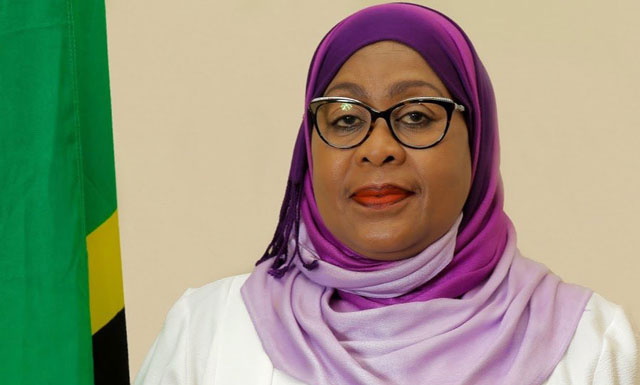
Tanzanian President Samia Suluhu Hassan, Tanzania’s first female head of state, in the East African region has been declared the winner of the country’s October 29th presidential elections, securing a landslide 97.66% of the vote.
Her win, in an election largely devoid of major opposition candidates, comes amid protests, violence, and growing international concern.
Tanzania’s Electoral commission chairman, Jacobs Mwambegele, announced the result on state television on Saturday,1st November,2025 saying Hassan, representing the ruling Chama Cha Mapinduzi (CCM) party, received 31,913,866 out of 32,678,844 votes cast, granting her a five-year term to lead the East African nation of approximately 68 million people.
“I declare Samia Suluhu Hassan the elected president of the United Republic of Tanzania through the CCM party,” Mwambegele, chair of the National Electoral Commission, said on the state television.
Hassan, who first assumed the presidency in 2021 following the death of her predecessor John Pombe Magufuli, appeared at an event in the administrative capital, Dodoma to receive her winner’s certificate.
“This result shows that Tanzanians have overwhelmingly voted for a female leader,” Hassan stated. “It is now time to unite our country and protect the progress we have built over six decades. We will work with all security agencies to ensure peace.”
The election, however, has sparked widespread criticism from opposition groups and human rights observers.
Many argued the vote was not a genuine contest but a coronation, as Hassan’s two main rivals were barred from running. She faced only 16 candidates from smaller political parties.
Protests erupted across the country following the announcement of results, fueled by claims of electoral irregularities and political repression.
Demonstrators took to the streets in major cities, tearing down campaign banners and setting government buildings on fire. Police responded with tear gas and live ammunition, while the military was deployed to quell unrest.
Reliable reports indicate that at least 10 people have been killed in Dar es Salaam, Shinyanga, and Morogoro towns, although Tanzanian authorities have not officially confirmed casualty figures. Internet blackouts have further disrupted communication, travel, and daily life.
The unrest also prompted the government to postpone the reopening of universities, initially scheduled for November 3rd. Security remains tight in major cities, with roadblocks and identity checks becoming a common sight.
The United Nations and international observers have expressed concern over the situation.
UN Secretary-General Antonio Guterres urged all parties to ‘prevent further escalation,’ while foreign ministers from the UK, Canada, and Norway highlighted ‘credible reports of a large number of fatalities and significant injuries’ linked to the security crackdown.
This election was a critical test for the ruling Chama Cha Mapinduzi (CCM) party, which has dominated Tanzanian politics for decades.
While opposition figures have gained popularity in recent years, such an overwhelming victory remains rare in the region, comparable only to leaders like Rwanda’s Paul Kagame.
As Tanzania moves forward, the challenge will be to keep peace, protect citizens’ rights, and encourage real political participation while keeping the country united amid demonstrations.
President Hassan’s victory secures her party’s dominance, but the unrest shows the importance of balancing stability with fairness and inclusion in the democratic process.