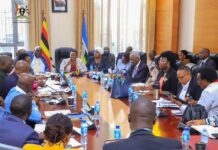

The government is planning to establish new border entry points along Uganda’s frontiers with Kenya and Rwanda as part of efforts to improve cross-border trade, facilitate movement and strengthen regional integration.
The announcement was made by the First Deputy Prime Minister and Minister for East African Community Affairs, Rebecca Alitwala Kadaga, shortly after successfully undergoing parliamentary vetting following her reappointment to Cabinet by President Yoweri Museveni for the 2026–2031 term.
Speaking to journalists at Parliament on Tuesday 2nd June , Kadaga said the proposed border posts are intended to reduce pressure on Uganda’s busiest crossings and create alternative trade routes for businesses and travelers.
“We are planning to create new border points, one with Rwanda and another at Buteba along the Kenya border, to decongest the existing border crossings, particularly Busia,” Kadaga said.
The proposed developments come at a time when trade volumes within the East African Community continue to grow, placing increased pressure on major border posts such as Busia and Malaba, which serve as critical gateways for goods entering and leaving Uganda.
According to Kadaga, the new crossings will not only improve the flow of cargo but also enhance the movement of people, support local economies and strengthen Uganda’s role within the regional market.
The veteran legislator also outlined her priorities for the new term, placing renewed emphasis on advancing the East African Community’s long-standing integration agenda.
She noted that efforts would be directed towards achieving the remaining objectives under the EAC Treaty, particularly deeper regional integration and the establishment of a political federation among member states.
“The plan is to ensure that the two remaining pillars of the treaty, integration and political federation, are realized during this term,” she said.
Kadaga further expressed concern over funding challenges facing the regional bloc, revealing that a significant share of the East African Community’s operational budget continues to be financed by a few member states.
She said Uganda, Kenya, Tanzania and Rwanda have consistently contributed to the community’s activities, while some partner states have struggled to meet their financial obligations.
“The others are not as compliant as they should be. I am planning to visit all the capitals and appeal to the respective governments because they are partners and benefit from the services of the Community. Therefore, they should also contribute,” Kadaga stated.
Analysts say improved border infrastructure could significantly enhance regional trade by reducing delays, lowering transport costs and improving connectivity between East African countries.
The East African Community remains one of Africa’s most ambitious regional blocs, bringing together Uganda, Kenya, Tanzania, Rwanda, Burundi, South Sudan, the Democratic Republic of Congo and Somalia under a common framework aimed at promoting economic growth, trade and political cooperation.
Parliament is currently continuing the vetting process for Cabinet nominees appointed by President Museveni as the government prepares to begin implementation of its agenda for the new five-year term.
If implemented, the proposed border projects are expected to strengthen Uganda’s position as a regional trade hub while supporting the broader vision of an integrated East African Community.