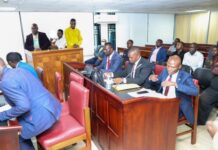

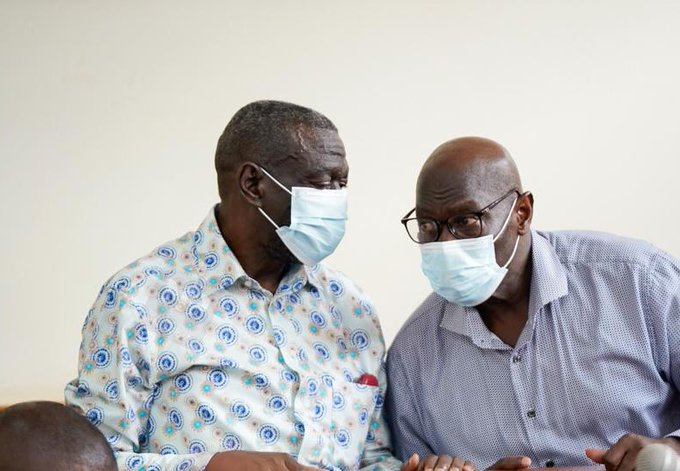
In a dramatic turn of events at the Nakawa Chief Magistrate’s Court, proceedings against opposition figure Dr Kizza Besigye and his co-accused, Hajji Obeid Kamulegeya, were abruptly terminated after the presiding magistrate declared she had no jurisdiction to hear the matter.
Chief Magistrate Christine Nantege’s announcement stunned a courtroom already tense with anticipation, effectively halting one of the country’s most politically charged trials in recent memory.
The ruling means the case can only proceed before the High Court or, possibly, a military tribunal, following Uganda’s recently amended legal framework that reintroduces military trials for civilians facing security-related charges.
Dr Besigye and Kamulegeya are facing treason charges that carry the possibility of a death sentence if proven. Their legal troubles stem from events following Besigye’s controversial abduction from Nairobi in November 2024 and subsequent detention in a military facility, a move that drew sharp criticism from local and international human rights organizations.
Speaking outside the court, Erias Lukwago, lead counsel for the accused, condemned the decision as an inadequate response to what he described as a fundamental injustice.
“Merely transferring the case to a higher court does not resolve the underlying issues,” Lukwago said.
“Our clients have suffered while on remand for over six months without trial. That in itself is a miscarriage of justice.”
He confirmed that a mandatory bail application will be filed at the High Court before Justice Baguma.
Meanwhile, Magistrate Nantege also declined to rule on a separate motion seeking to remove herself over the alleged bias and incompetence, a move that left lingering questions about judicial accountability and added another layer of tension to an already volatile case.
The decision comes less than two weeks after President Yoweri Museveni signed into law a controversial amendment reinstating military trials for civilians accused of security-related offenses. Given Dr Besigye’s past ties to the military, fears are growing that his case may now fall within that expanded legal pathway.
As uncertainty looms over the next steps, one thing is clear: Uganda’s lower courts are increasingly unwilling to shoulder the political and legal weight of opposition trials. With the judiciary under intensifying scrutiny, questions about fairness, independence, and the rule of law continue to intensify.