


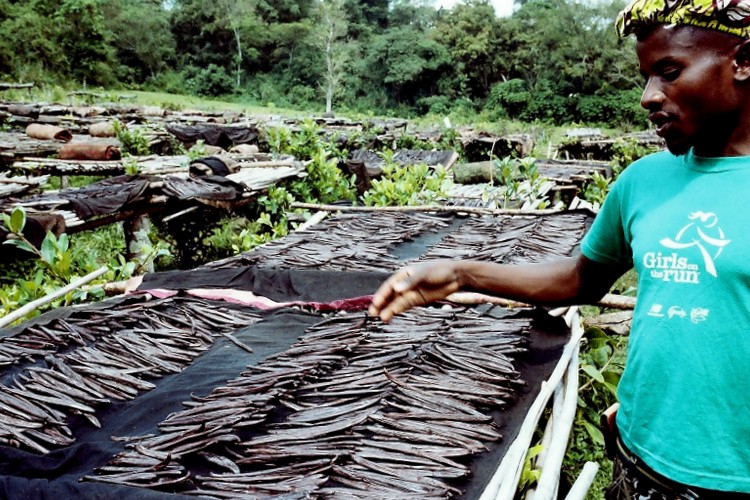
Government has announced official harvest dates for the upcoming Vanilla Season B, a move aimed at safeguarding product quality, preventing premature picking, and strengthening the country’s position as a leading global supplier of high-grade vanilla.
The Ministry of Agriculture, Animal Industry and Fisheries (MAAIF) declared that the harvest window will run from 29th December 2025, to 29th March 2, 2026, urging farmers to pick only mature beans to maintain Uganda’s rising demand and profitability on the international market.
Addressing journalists at the Uganda Media Center, on 4th December, 2025, the State Minister for Agriculture Fred Bwino Kyakulaga reaffirmed the government’s commitment to transforming Uganda’s vanilla industry through strengthened regulations and coordinated enforcement.
“This harvest window is not just a date, it is a promise to our farmers that we will protect their hard work from theft, illegal trading, and poor practices that damage our global reputation,” Kyakulaga said.
“By harvesting beans that are at least nine months after pollination, we guarantee the aroma and vanilla in levels above 4%, making Ugandan vanilla irresistible to buyers in the US and EU,” he added.
Uganda’s declaration follows a record-breaking year for vanilla exports. In 2024, the country shipped 604 metric tons more than double the 266 metric tons exported the previous year earning USD 16.6 million in foreign exchange.
Kyakulaga credited this growth to extensive maturity surveys and farmer training conducted by MAAIF in collaboration with the Association of Vanilla Exporters Uganda (VANEX), Makerere University, and Catholic Relief Services (CRS).
Uganda’s market share in major markets has surged sharply, rising from 3% to 12% in the United States and from 1% to 10% in the European Union. This success is driven by the country’s unique advantage of two annual harvest seasons and widespread organic farming methods that appeal to premium buyers.
However, the minister cautioned that serious challenges persist, with premature harvesting, bean theft, and illegal trading still widespread in the 25 key vanilla-growing districts across central, eastern, and western Uganda.
“These malpractices dilute our quality and expose farmers to price shocks on the international market,” he warned.
To address this, the minister directed district task forces, agriculture police, and local government teams to step up enforcement.
Measures include the rollout of digital traceability systems, strict maturity verification, and increased community surveillance. So far, 15 districts have passed rules to regulate vanilla production, with both national and district task forces established to ensure compliance.
“We are introducing digital traceability tools and training programs to ensure every bean tells a story of Ugandan excellence,” Kyakulaga noted.
He also urged exporters, curers, and traders to follow established best practices or face penalties.
Vanilla remains one of Uganda’s most lucrative crops, consistently commanding the highest price per kilogram among local commodities despite global market fluctuations.
Since 2019, MAAIF has emphasized standardized planting and harvesting cycles to improve quality and stabilize market prices, an approach that continues to be refined annually based on field data and seasonal weather patterns.
As Uganda enters Season B, the government’s renewed focus on quality and enforcement offers farmers a better chance at fair prices and stable markets.
With disciplined harvesting and stronger safeguards, vanilla growers can look forward to a more predictable, profitable, and internationally respected sector.