

The death toll from last week’s devastating landslides in the Sebei Sub-region has risen to 21, highlighting the growing vulnerability of Uganda’s mountainous eastern highlands to climate change and environmental degradation.
Five more bodies, including two infants, were recovered on Monday, 1st November, 2025 in the evening from Kwanwa Village, Kapteka Parish in Chesower Sub-county, Bukwo District, bringing the confirmed fatalities to seven in Bukwo, six in Kween, and five in Kapchorwa. At least 11 people remain missing, feared buried under thick mud and massive rocks.
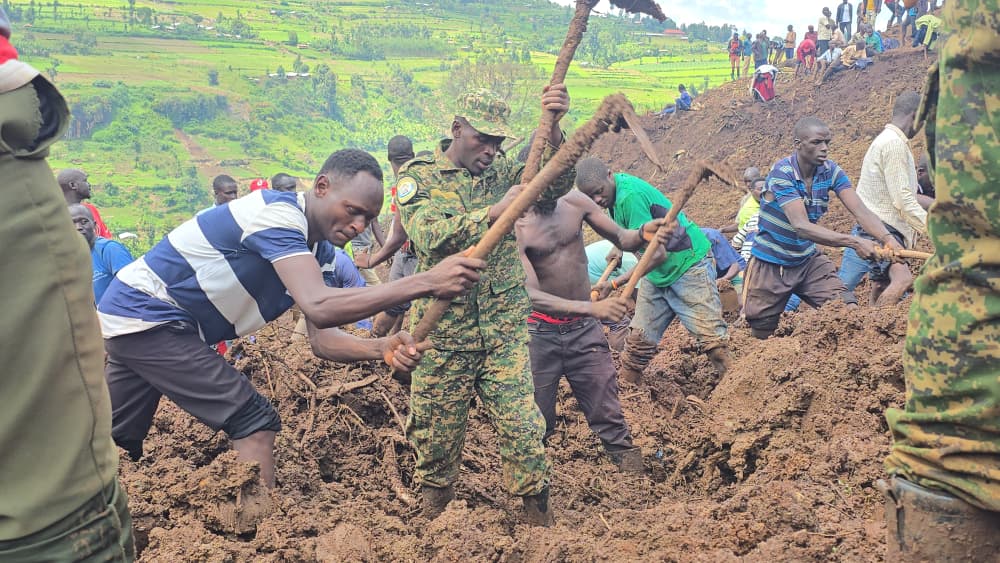
The landslides, triggered by days of torrential rainfall between 30th October and 1st November, buried entire homesteads and destroyed farmlands. Desperate residents have been using rudimentary tools to dig through the rubble in search of their loved ones.
“This morning, we exhumed two infants from a family of seven, and the remaining five are still underground,” Sylus Chesan, one of the locals leading the community search effort said.
Rescue operations are being supported by the Uganda Police Force and the Uganda People’s Defence Forces (UPDF), but officials say poor access due to washed-out bridges and blocked roads continues to hamper progress.
According to authorities, the Sebei highlands covering Bukwo, Kween, and Kapchorwa districts have become increasingly prone to landslides due to deforestation, poor land-use practices, and shifting rainfall patterns. The once-forested steep slopes have been heavily cultivated and settled on, leaving the soils loose, unstable and fragile under heavy rains.
Fredmark Chesang, the Sipi Regional Police spokesperson, confirmed that nine survivors have so far been rescued and that operations are ongoing despite continued rainfall.
Visiting the area on Sunday, 2nd November, 2025, the State Minister for Disaster Preparedness Lilian Aber attributed the growing frequency of landslides to environmental degradation and erratic weather patterns.
“We are witnessing the consequences of living and cultivating in high-risk zones however Government has ordered immediate relocation and is working with the Uganda Red Cross to provide relief and temporary shelter,” Aber stated.
She added that Moyok in Kween District has been identified as a temporary resettlement site for displaced families, while the Office of the Prime Minister (OPM) and Red Cross teams continue conducting damage assessments and verifying victims.
With heavy rains still pounding the Elgon ranges, disaster officials have warned of more potential landslides in the coming days.
Residents are urging government to fast-track a permanent resettlement plan and invest in long-term measures such as reforestation, improved drainage systems, and climate-resilient land management.
While temporary relief and rescue efforts provide immediate support, experts stress that long-term solutions such as reforestation, regulated farming on steep slopes, and robust early warning systems are critical to preventing future loss of life and livelihoods in this vulnerable region.