


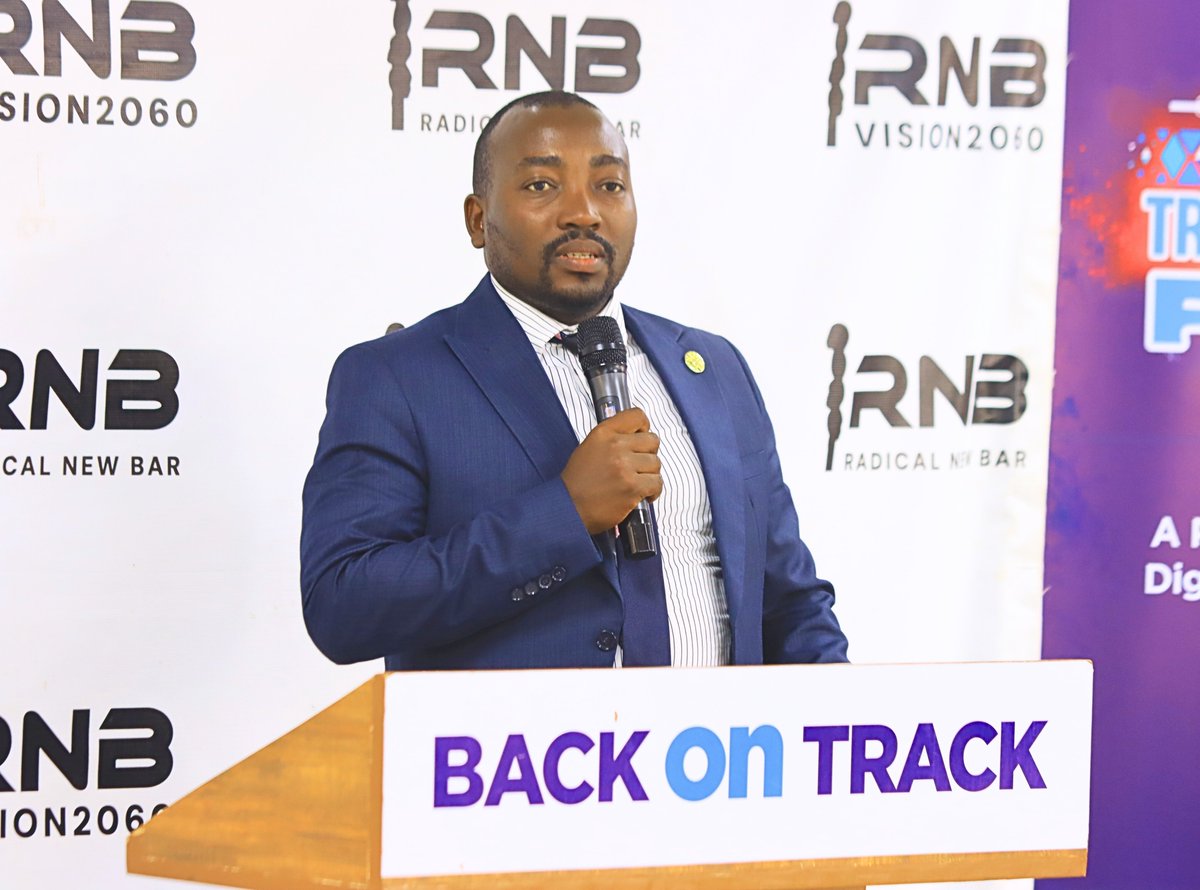
The Uganda Law Society (ULS) has observed the first anniversary of the enforced exile of its President, Isaac Kimaze Ssemakadde, with a renewed call for judicial independence and protection of civic space.
The commemoration took place on 19th February, 2026, during the Society’s third Radical New Bar (RNB) Live session held at ULS House on John Babiiha Road in Kampala under the theme ‘Civic Space at Stake.’
Lawyers, engineers, civil society actors and media professionals gathered to reflect on recent NGO suspensions and broader concerns about rule of law.
In a message delivered on his behalf by ULS Central Region Representative Alexander Lule, Ssemakadde described the judiciary as a power tool in the hands of dictatorial regimes.
The ULS President accused lawyers aligned with the regime of abandoning their professional independence, saying some had reduced themselves to ‘wigged bootlickers’ who, in his view, are weakening the very foundations of justice and undermining the integrity of the legal profession.
“Some lawyers have abandoned their professional independence, becoming ‘wigged bootlickers’ who weaken the foundations of justice and compromise the integrity of the legal profession,” Ssemakadde said.
His remarks influenced the discussion, which repeatedly emphasized resistance, institutional accountability, and the protection of democratic freedoms.
The session was moderated by Robert Jurua, who emphasized that ULS was acting within its statutory mandate under Section 3 to uphold the rule of law and defend constitutionalism.
It also featured governance expert Godber Tumushabe, alongside civil society leaders like Henry Muguzi and Peter Magelah, who analyzed the January 2026 suspension of 10 non-governmental organizations, including the Alliance for Finance Monitoring and Chapter Four Uganda, which were halted under Section 42(d) of the NGO Act over alleged threats to national security.
Panelists, including professionals from the engineering and media sectors, shared personal accounts of exile and institutional pressure.
They challenged the suspension procedures, citing insufficient evidence, vague proof requirements, and a lack of due process, while collectively calling for judicial reform, the restoration of civic freedoms, and strengthened resilience against what many described as institutional capture.
The panelists drew attention to the ripple effects of the crackdown, including delayed salary payments, terminated contracts, and a growing culture of self-censorship within civil society.
Muguzi described the suspensions as a form of ‘securitization,’ a practice in which people with opposing voices are portrayed as threats to national security in order to justify restrictive action.
He argued that this approach weakens transparency and discourages legitimate public scrutiny of government actions.
“Treating criticism as a threat silences legitimate scrutiny of government actions,” Muguzi stated.
Governance expert Tumushabe, emphasized that civic resistance must be sustained, drawing inspiration from civil rights leader Martin Luther King Jr., who urged individuals to use their time and agency to create social change.
Magelah tied the suspension of NGO activities to election-related civic engagement, arguing that the measures hindered independent monitoring and citizen participation, while Mpuga of the Uganda Institution of Professional Engineers called for creative, interdisciplinary solutions to counter the steady decline in civic freedoms, stressing that defending rights should not be the responsibility of lawyers alone.
As the anniversary of Ssemakadde’s exile was marked, the ULS made its message clear: defending civic space and upholding the rule of law is an ongoing struggle and a collective responsibility for all Ugandans.
Through its Radical New Bar platform, the Society signaled that it intends to continue challenging policies and practices it believes undermine democratic governance in Uganda.