

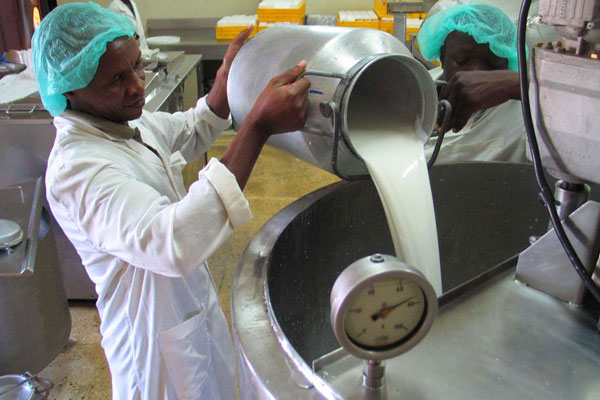
President Yoweri Kaguta Museveni has cited Uganda’s dramatic increase in milk production over the past four decades as one of the country’s most significant economic transformation success stories, revealing that annual output has grown from approximately 200 million litres in 1986 to 5.4 billion litres today.
Speaking during the 2026 State of the Nation Address at the Kololo Ceremonial Grounds, Museveni said the growth demonstrates the impact of shifting households from subsistence livelihoods to commercial production and active participation in the money economy.
The President pointed to the transformation of communities within Uganda’s cattle corridor as evidence that targeted mobilization, improved farming practices, and market-oriented production can significantly improve household incomes and drive national economic growth.
According to Museveni, efforts to encourage livestock farmers to adopt modern farming methods and improve their breeds have played a key role in the expansion of the dairy sector.
“That was all. They converted their indigenous Ankole cattle into half-breeds with the Friesians and they took off,” Museveni told Parliament.
The President traced the origins of the transformation agenda to early development debates and mobilization campaigns that sought to move Ugandans away from what he described as subsistence production and into a structured money economy.
He explained that for many years, government efforts have focused on encouraging households to engage in commercial agriculture, enterprise development, and other productive economic activities capable of generating sustainable incomes.
Museveni said the success recorded in the dairy sector demonstrates what can be achieved when communities embrace commercial production and apply modern agricultural techniques.
The President also used the opportunity to defend government wealth-creation initiatives, including the Parish Development Model (PDM), Emyooga, Operation Wealth Creation, and the National Agricultural Advisory Services (NAADS), saying the programmes were specifically designed to help more households transition into income-generating activities.
He emphasized that while government has invested substantial resources in these programmes, their effectiveness depends on proper implementation and committed leadership at all levels.
Beyond agriculture, Museveni highlighted progress in infrastructure development, industrialization, electricity generation, and export growth as indicators of Uganda’s broader economic progress since 1986.
He noted that electricity generation has increased from approximately 60 megawatts in 1986 to more than 2,000 megawatts today, providing the energy needed to support industrial development and investment.
The President argued that these developments have contributed to Uganda’s transition into a lower-middle-income economy and laid the foundation for future growth.
However, he cautioned that sustaining the gains made over the years will require greater accountability, discipline, and commitment from leaders entrusted with implementing government programmes.
Museveni criticized what he described as non-performance and a culture of dependency among some public officials, warning that public service should focus on results rather than personal benefits.
“Either you lead or you stay in your home,” he said.
The President further stressed that government programmes must translate into tangible improvements in household incomes if Uganda is to achieve its long-term development goals.
He urged leaders across the country to intensify efforts aimed at mobilizing communities against poverty and ensuring that wealth-creation initiatives reach intended beneficiaries.
The remarks formed part of Museveni’s broader message on economic transformation, productivity, and wealth creation during his 32nd State of the Nation Address, where he called for renewed focus on moving every household into the money economy.
With milk production now standing at 5.4 billion litres annually, the President said Uganda’s dairy industry offers a practical example of how targeted interventions, improved production methods, and sustained mobilization can transform livelihoods and contribute to national prosperity.