

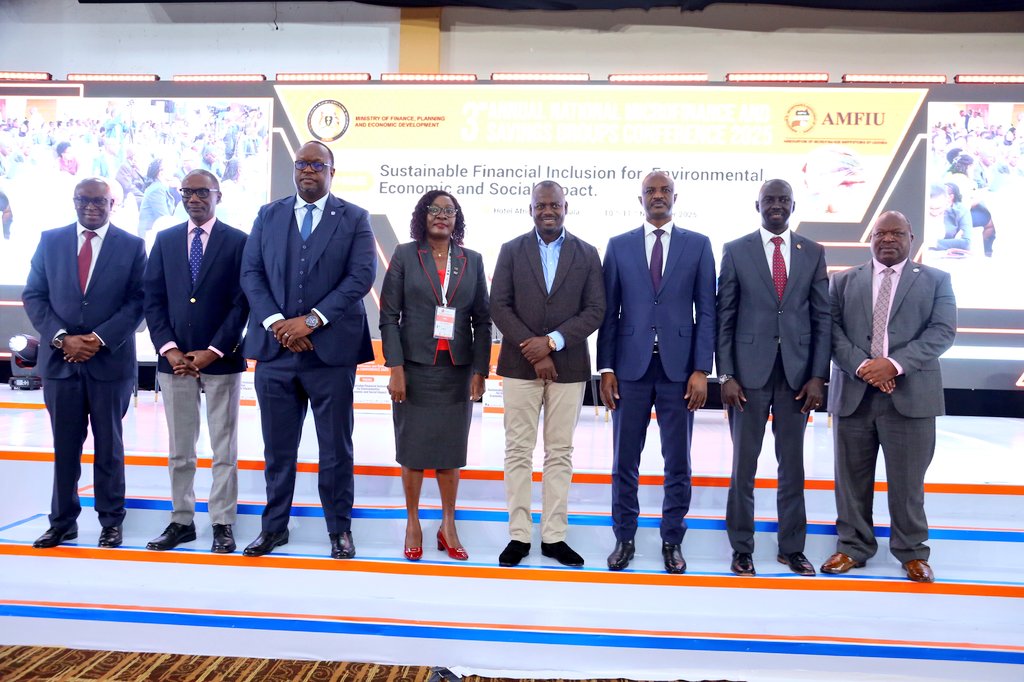
Permanent Secretary and Secretary to the Treasury (PS/ST) at Uganda’s Ministry of Finance, Planning and Economic Development, Ramathan Ggoobi, has called for a pivotal shift from theoretical financial education to hands-on practical skills to foster economic growth in Uganda.
PSST Ggoobi, who was speaking at the 3rd National Microfinance & Savings Groups Conference at Hotel Africana in Kampala on 10th November, 2025 urged stakeholders to adopt real-world applications for better outcomes. He stressed the need for innovative, inclusive finance to drive prosperity, aligning with Uganda’s National Development Plan.

According to him, microfinance has long stood as a transformative force, a catalyst for change that lifts families out of poverty, empowers women and fuels the growth of micro and small enterprises.
“I have always said that there are arguably two “opportunity equalizers” in life-education and financial inclusion,” Ggoobi said.
He noted that microfinance is one of the key buttons that are going to enable Uganda to become a 500-billion-dollar economy that works for all.
Organized by the Association of Microfinance Institutions of Uganda (AMFIU), the conference features key stakeholders including Ggoobi, financial ecosystem leaders, policymakers, and microfinance practitioners.
Executive Director David Baguma, Association of Microfinance Institutions of Uganda (AMFIU) said that this shift is crucial for building resilient financial systems that truly serve the underserved.
The Minister of State for Microfinance, Al-Hajj Haruna Kyeyune Kasolo said Government of Uganda remains firmly committed to inclusive prosperity and to realizing a Uganda where no one is left behind.

Kasolo applauded the enactment of the National Payment System Act, adding that the national payments framework reform has been instrumental in strengthening Uganda’s financial architecture and reinforcing the foundations for sustained economic growth.
He said improved regulatory environment has also catalyzed innovation within the financial sector, enabling new solutions that simplify transactions while reducing associated risks and costs.
“In communities that previously had no banks or reliable access points, digital innovations such as Post Bank’s Wendi Mobile Wallet, Stanbic’s FlexiPay, Ensibuuko’s digital platforms, among others, have significantly eased access to financial services,” Minister Kasolo stated.
The two-day event runs from November 10-11, 2025, coinciding with ongoing efforts to enhance financial literacy amid economic challenges in financial education and inclusion, emphasizing practical approaches to empower stakeholders, particularly in microfinance, which serves over 2 million Ugandans through savings groups and institutions.

Through keynote speeches, interactive sessions, and collaborative recommendations, the conference promotes actionable strategies like skill-based training to boost economic participation.
The conference, held under the theme, “Sustainable financial inclusion for environmental, economic, and social impact,” underscores Uganda’s commitment to transforming microfinance into a practical engine for economic empowerment.