


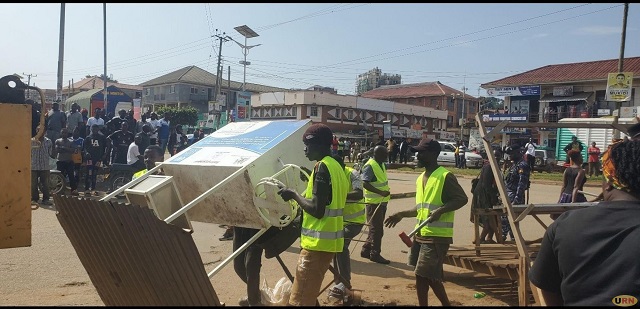
Government has suspended the enforcement of its disputed “trade order” targeting kiosks and street vendors across urban centres, following mounting pressure from traders, religious leaders and Members of Parliament.
The decision, announced this week by State Minister for Trade David Bahati, pauses ongoing operations until at least July to allow for consultations and a review of the implementation approach.
The directive had triggered widespread concern after enforcement teams moved to remove roadside vendors and informal kiosks in several towns, prompting accusations of abrupt evictions and disruption of livelihoods.
During a heated parliamentary session, Bukooli Central MP Solomon Silwany questioned the manner in which the exercise was carried out, saying affected traders were being displaced without adequate notice or guidance.
“Enforcement teams are abruptly removing kiosks and goods,” Silwany told Parliament, raising concerns about the lack of prior briefing to legislators.
Kira Municipality MP Ibrahim Ssemujju Nganda also criticised the operation, alleging irregularities in enforcement and calling for clarity on the legal framework guiding the crackdown, as well as possible compensation for affected traders.
“We must implement these orders with a human face,” he said.
In response, Bahati acknowledged gaps in execution and apologised to stakeholders, including members of the Inter-Religious Council, over how the operation was conducted. He maintained that the policy itself is intended to streamline urban trade, reduce congestion, and encourage the use of designated markets, but conceded that its rollout had been mishandled.
Government now plans to engage a broad range of stakeholders including trader associations, religious leaders, and officials from the Ministry for the Presidency before determining the next course of action.
Acting Leader of the Opposition Jonathan Odur welcomed the suspension but criticised what he described as reactive policymaking.
“There is a pattern of acting first and consulting later,” he said, urging authorities to balance regulation with the economic realities facing small-scale traders.
The review process is expected to run through June, with a revised enforcement strategy likely to be unveiled in July.
For now, the suspension offers temporary relief to thousands of informal traders whose businesses had been directly affected, while opening a wider debate on how to regulate urban commerce without undermining livelihoods.