
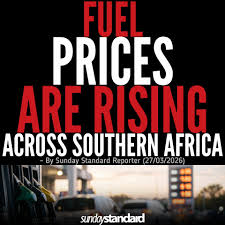
The latest fuel price increases announced by the government of South Africa, effective April 1, 2026, reflect mounting global energy volatility and underscore growing pressure on the country’s already fragile economic environment.
Authorities confirmed petrol prices will rise by R3.06 per litre for both 93 and 95 octane, while diesel critical for transport, agriculture, and industry will increase sharply by R7.37 per litre for 0.05% sulphur diesel and R7.51 per litre for 0.005% sulphur diesel.
Wholesale illuminating paraffin will rise by R11.67 per litre, raising concerns for low-income households that rely on the fuel for cooking and lighting.
The adjustments follow a steep increase in global crude oil prices from $69.08 to $93.67 per barrel, driven largely by escalating geopolitical tensions between the United States and Iran, alongside a weakening rand that slipped from R16.00 to R16.64 against the US dollar.
Analysts say the fuel price surge illustrates how exposed South Africa remains to external shocks, particularly fluctuations in oil markets and currency volatility.
Rising tensions between the United States and Iran have historically triggered instability in global oil supply expectations, often pushing prices upward even before actual disruptions occur.
The rand’s depreciation has further amplified the cost of imports, compounding pressure on fuel consumers.
This combination highlights the structural vulnerability of the South African energy sector and its sensitivity to geopolitical developments beyond its control.
While petrol price increases directly affect private motorists, the steep diesel adjustment is expected to have broader macroeconomic consequences.
Diesel powers freight logistics, mining operations, agricultural machinery, and public transport systems across South Africa.
As a result, economists warn the increases could trigger secondary inflation through higher transport costs, rising food prices, and increased production expenses.
For a country already grappling with slow economic recovery, high unemployment, and cost-of-living pressures, the diesel price spike presents a significant policy challenge.
The latest price adjustments reinforce calls for accelerated investment in alternative energy sources, refining capacity expansion, and policies that reduce reliance on imported fuel products.
Without structural reforms in the energy sector, analysts warn that recurring global shocks will continue translating into domestic economic strain placing pressure on households, businesses, and fiscal policy planning alike.
The April 2026 fuel adjustment therefore represents more than a routine monthly revision; it signals how global geopolitical tensions are increasingly shaping everyday economic realities across South Africa and the wider region.