
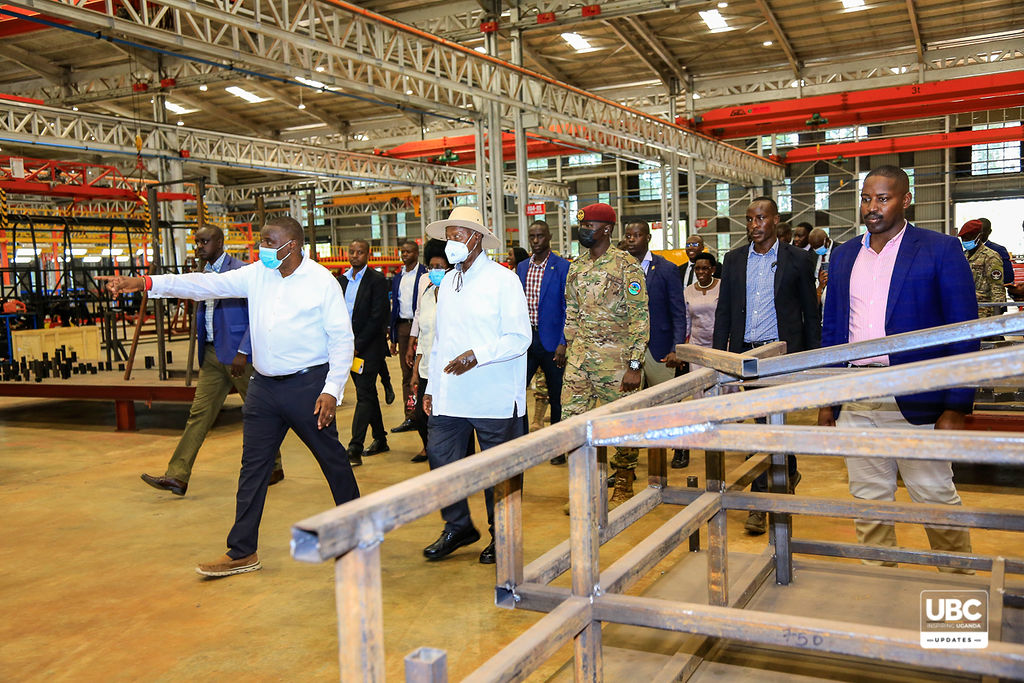
President Yoweri Kaguta Museveni has officially commissioned the Kiira Vehicle Plant in Jinja, describing it as key achievement in Uganda’s pursuit of industrialization and economic self-reliance.
Speaking at the event on 26th September 2025, the President said the factory reflects the partial implementation of Uganda’s long-standing vision of vertical and horizontal integration, first outlined in the National Resistance Army’s 10-point program.
He explained that vertical integration involves using local resources, such as iron ore and lithium, to produce inputs for industries like vehicle manufacturing, while horizontal integration connects different sectors such as transport, tourism, and education to strengthen the broader economy.
“The vehicles need batteries that use lithium, and there is quite a bit of lithium in Ntungamo. Soon, with our iron ore in Kabale, we shall also produce our own steel,” Museveni said, noting that Uganda currently spends about $900 million annually on steel imports.
The President also announced that Uganda will host regional presidents in Tororo on October 18 for the ground-breaking of a steel plant that will refine and process local ore into high-quality steel, feeding industries such as Kiira Motors.
Museveni highlighted that Uganda’s economy is on a strong growth trajectory, projected at 7% this financial year and expected to rise to 10% with the commencement of oil production.
“There is nothing that will stop us because we are clear about what is required to transform society,” he said, emphasizing the need to leverage local skilled scientists, abundant electricity, and natural resources to sustain growth.
The Kiira plant, the President noted, marks the first serious integration of Uganda’s transport sector into local industry, which until now has depended largely on imports from Japan and other countries.
He argued that this shift would save significant foreign exchange and stimulate other economic sectors.
Using Kiira Motors as an example, Museveni compared its progress to the dairy sector, explaining how Uganda moved from relying on imported condensed milk from New Zealand to building a fully integrated dairy industry that now exports products like Kaasen protein to the United States.
“What is the point of bringing tourists here if they are consuming milk from New Zealand? All the money they bring goes back,” he remarked, stressing that the same model of integration should now apply to vehicle manufacturing.
He added that successful local production at Kiira Motors would save Uganda billions in imports, create jobs, and stabilize the economy.
“Uganda now has the skilled labor, the raw materials, and the demand to build its own industries. Kiira is a good beginning, and if we do it successfully, we shall save and also earn hundreds of millions of dollars,” Museveni added.
The President praised Paul Isaac Musasizi, CEO of Kiira Motors, for his role in expanding the project into a full-scale vehicle plant and revealed ongoing discussions with investors to further develop the factory.
Museveni also highlighted the stability of Uganda’s economy, noting that the shilling is gaining against the dollar and the country is steadily reducing its reliance on imports.
He encouraged scientists to intensify research into traditional medicine, claiming that Uganda has already discovered potential cures for diabetes and malaria.
“With science, innovation, and our natural heritage, we can heal diseases and transform our economy,” he said.
The President also praised Makerere University, Kiira Motors, and the National Enterprise Corporation for demonstrating Uganda’s capacity to deliver on ambitious industrial projects.
Museveni’s commissioning of the Kiira Vehicle Plant highlights Uganda’s push to build local industries, create jobs, and reduce dependence on imports. The project demonstrates how the country can use its natural resources, skilled workforce, and innovation to drive economic growth and position itself as a hub for industrial development in the region.