
More than half of Moroto District’s rural villages now have access to safe water sources, as new dams and water infrastructure projects advance rapidly to support communities and boost local livelihoods.
According to data from the Moroto District Water Officer Musa Lowot, out of 233 rural villages, 133 representing 57 percent currently have access to safe water sources.
However, 100 villages, or 43 percent, remain without safe water, a gap the government says it is determined to close through new infrastructure investments.
He commends the government’s continued investment in water infrastructure across Karamoja.
“For the first time in years, we are seeing real progress. The desilting of Kobebe Dam and the completion of Nadipal Valley Tank are major milestones,” Lowot said.
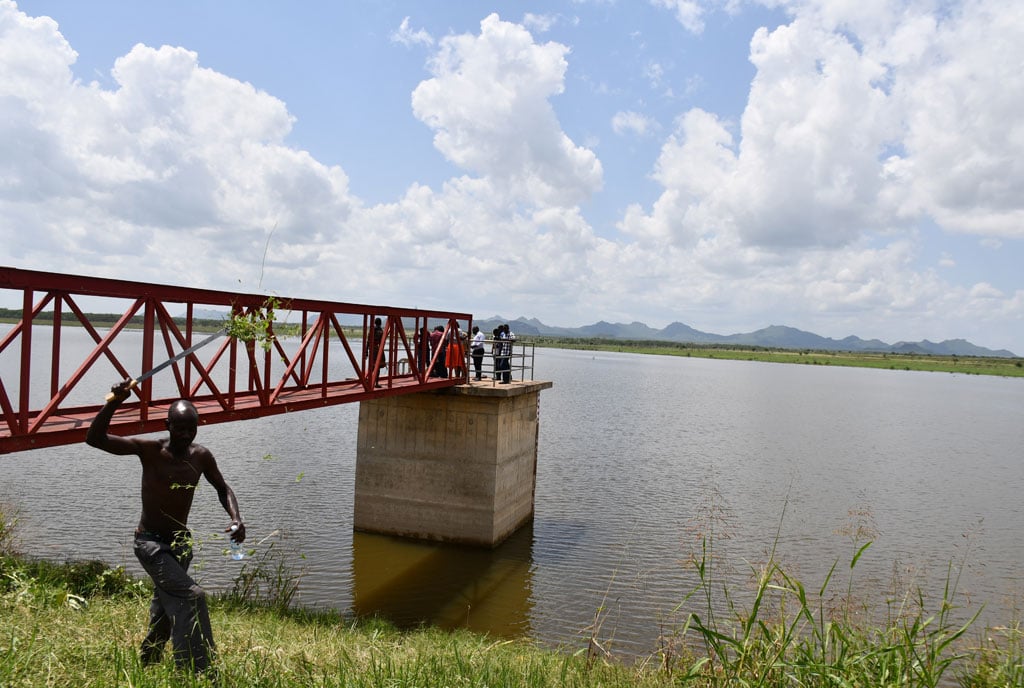
The Ministry of Water and Environment (MoWE) is currently undertaking several key projects under the Water for Production initiative. Among them is the desilting of Kobebe Earth Dam, which will increase its storage capacity and reliability for pastoral and agricultural use.
The Nadipal Valley Tank in Nadunget Sub-county was completed and handed over in December 2023. The Nakonyen Valley Dam in Tapac Sub-county, which will hold 1.5 billion litres of water, is nearing completion and is expected to be operational by November 2025.
Moroto also boasts 11 valley tanks and 2 wind-powered water systems that are currently operational, serving communities and livestock keepers across the district.
“These projects are not only about drinking water, they are about supporting livelihoods through irrigation and livestock farming,” Lowot explained.
Beyond dams and tanks, a solar-powered irrigation system is under construction, signaling a shift towards sustainable and climate smart water use in agriculture.
Wetland conservation is also being considered, as a big part has been degraded, mainly due to human activity and encroachment.
While the progress is commendable, challenges remain especially in reaching the 43 percent of villages still without safe water. Limited funding, harsh climatic conditions, and the vastness of the district continue to slow down service delivery.
Even so, Moroto’s leadership remains optimistic that they are are moving in the right direction as every new borehole, every dam, every tank brings them closer to a water secure Moroto.
On June 12th, 2025, Finance Minister Matia Kasaija while delivering the 2025/2026 budget speech announced the government’s plan to boost funding for safe water access, sanitation systems, and environmental protection across the country in the upcoming financial year.
“We are committed to ensuring clean water access in both rural and urban communities, as well as in refugee settlements,” Kasaija said.
He revealed that 8 out of every 10 villages in Uganda now have at least one source of safe water. This translates to 57,951 out of the 71,225 villages that are currently served; a key milestone in the country’s push to improve public health and living conditions.
“That is why I have allocated an additional Shs 366.1 billion for water resources management, climate change mitigation, and environmental protection,” he remarked.
As government investments continue, there is hope that by 2026, access to clean water will no longer be a privilege but a guaranteed right for every household in Moroto District.