
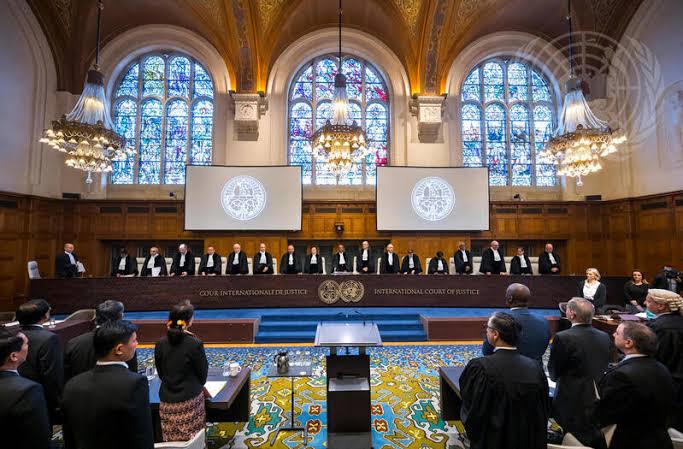
The world’s highest court will open a decisive new chapter in the pursuit of justice for the Rohingya people when it begins public hearings on 12th January, 2026, in a major genocide case against Myanmar.
This was announced by the International Court of Justice (ICJ) on Friday, 19th December, 2025, that it will hear arguments in the case of The Gambia v. Myanmar from 12th January to 29th January, 2026, marking the long-awaited merits phase of proceedings.
Filed in November 2019, the case accuses Myanmar of breaching the Genocide Convention through the actions of its military during a 2017 campaign in Rakhine State.
That campaign triggered widespread violence and forced more than 700,000 Rohingya Muslims to flee to neighboring Bangladesh, creating one of the world’s largest refugee crises.
According to the Court, the hearings will allow both parties to present their full legal arguments before judges deliberate toward a final ruling.
“Both sides will have the opportunity to lay out their legal cases in detail before the judges decide on the matter,” the ICJ statement read.
The application brought by The Gambia asks the Court to declare that Myanmar has violated its obligations under the Genocide Convention, to order an immediate end to any continuing breaches, to require reparations for victims, and to guarantee non-repetition of the alleged acts.
The Court’s jurisdiction in the case is grounded in Article IX of the Genocide Convention, which permits disputes between states concerning genocide to be referred to the ICJ.
This is not the first time the Court has intervened.
In January 2020, the ICJ issued provisional measures directing Myanmar to prevent acts of genocide, preserve evidence, and report regularly on steps taken to comply with the order.
The case has drawn significant international attention.
Eleven countries, including Canada, France, Germany, and the United Kingdom, have participated by submitting written legal observations to the Court.
The ICJ confirmed that these submissions are sufficient and that those states are not required to take part in the oral hearings.
As the hearings approach, the proceedings are widely seen as a critical test of international accountability mechanisms and a rare opportunity for judicial scrutiny of alleged genocide at the state level.
For the Rohingya people, the hearings represent a renewed moment of hope that justice, long delayed, may finally be within reach.