

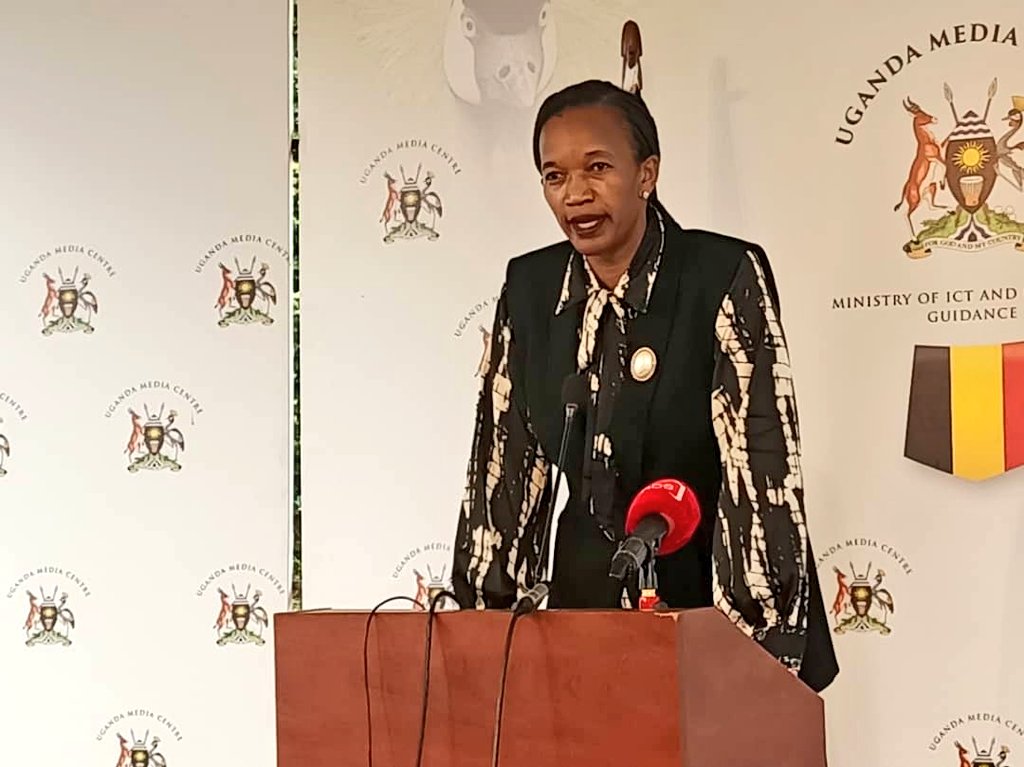
The Government of Uganda has announced strengthened measures aimed at promoting safe labour migration and protecting Ugandans seeking employment abroad, as part of renewed efforts to regulate the country’s labour externalization programme.
Speaking during a press conference held at the Uganda Media Centre on Thursday, 5th February, 2026, the Minister of State for Labour, Esther Davinia Anyakun, reaffirmed the government’s long-standing commitment to transforming labour externalization into a secure, orderly, and mutually beneficial process for both workers and the national economy.
Anyakun recalled that in 2005, the Ministry of Gender, Labour and Social Development (MGLSD) launched the Externalization of Labour Programme with two key objectives which include; establishing a formal and secure pathway for Ugandans seeking employment overseas, and providing a short-term intervention to ease the country’s unemployment burden.
“Since its inception, the programme has aimed to ensure that labour migration benefits individual workers and strengthens national development, however persistent challenges remain, including cases of abuse, exploitation, and unsafe working conditions reported by some Ugandans working abroad,” Anyakun revealed.
“Today’s briefing highlights our determination to strengthen oversight, regulation, and support systems within the labour export sector,” she added.
The minister highlighted ongoing collaboration between government, licensed recruitment agencies, host countries, and international partners to enforce compliance with bilateral labour agreements and international labour standards.
Among the key measures announced were intensified screening and licensing of labour export companies to eliminate unethical practices, expanded pre-departure training and orientation programmes covering workers’ rights, personal safety, and emergency response, and strengthened monitoring mechanisms through dedicated labour support desks at Ugandan embassies abroad.
She also noted improved coordination with diaspora units to respond swiftly to cases involving distressed workers and renewed calls for Ugandans to use only government-approved recruitment channels and to report irregularities promptly.
Anyakun cautioned Ugandans intending to work abroad to verify recruitment agencies through official Ministry channels and to prioritize documented, contract-based employment opportunities.
She further noted that the government remains committed to addressing broader labour market challenges, including youth unemployment and the promotion of decent work opportunities within Uganda.
The minister revealed that additional stakeholder engagements, regulatory reviews, and policy reforms have been planned in the coming months to further strengthen protection for Ugandan migrant workers.
The press conference forms part of the Ministry of Gender, Labour and Social Development’s ongoing public awareness campaign on safe and dignified labour migration, as the government intensifies efforts to curb illegal recruitment, protect migrant workers, and ensure that overseas employment opportunities are pursued through regulated and lawful channels.
Authorities have emphasized that safeguarding Ugandans abroad remains a national priority, with sustained reforms aimed at making labour migration safer, more transparent, and beneficial to both workers and the country at large.