

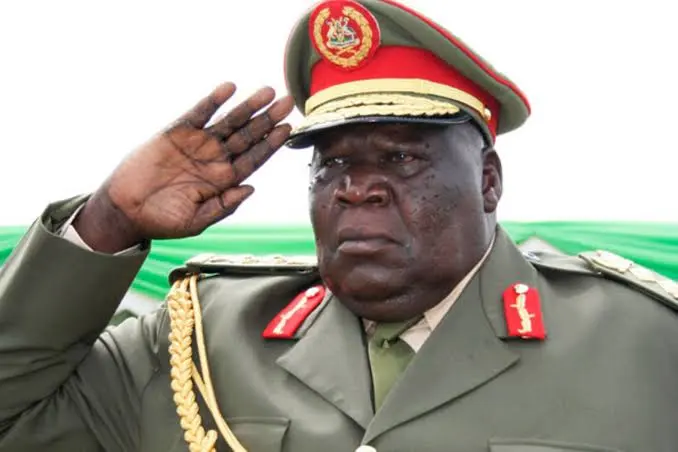
General Moses Ali, one of Uganda’s longest-serving political and military figures, has died at the age of 87.
He passed away at Nakasero Hospital on Saturday at 4:00 p.m., bringing to a close a public career that spanned more than six decades.
The announcement was made by President Yoweri Kaguta Museveni, who described the late General as a dedicated servant of Uganda.
“It is with deep sorrow that I announce the death of our brother Gen Moses Ali. He died today at Nakasero Hospital, at 1600 hours. Gen Moses Ali has provided service to his country for a long time, as a soldier and a political leader,” the President said.
Museveni also praised Moses Ali’s contribution beyond politics, noting that he set “a good example of being a big modern farmer” in the West Nile region.
“We shall miss greatly his contribution. May the Almighty God rest his soul in eternal peace,” President Museveni added.
Few leaders remained at the centre of Uganda’s political and military affairs for as long as General Moses Ali. From his early years in the military to serving under different governments, surviving exile, and later becoming one of President Museveni’s most trusted ministers, his career reflected many of the defining moments of Uganda’s post-independence history.
He first rose to prominence as a soldier before serving as Minister of Finance during the Idi Amin administration. Following the fall of Amin’s government in 1979, he went into exile before later returning to Uganda and reconciling with the National Resistance Movement (NRM) government. That reconciliation marked the beginning of another lengthy chapter of public service.
For decades, General Moses Ali represented Adjumani West in Parliament and served as Second Deputy Prime Minister, among other senior Cabinet positions. Even as advancing age and declining health limited his mobility, he remained committed to public service, continuing to attend official duties whenever his condition allowed.
His passing has prompted tributes from across the country. Journalist Alan Kasujja, the Executive Director of Uganda Media Centre reflected on the General’s lifelong commitment, writing that he “gave Uganda everything; his youth, his strength, and in the end, whatever was left of him.” Kasujja added that Moses Ali remained in service even when age had taken its toll, describing his dedication as “true service to the fatherland.”
The Minister for Local Government, Balaam Barugahara Ateenyi described Moses Ali as “the revolutionary father of West Nile” and praised his contribution to peace and national unity. He said the late General played a pivotal role in pacifying the West Nile region through dialogue, peace talks, and reconciliation, helping restore stability after years of conflict.
Barugahara also hailed Moses Ali’s contribution to Uganda’s liberation struggle, peace, stability, and development, saying his legacy would endure for generations. He remembered him as “a disciplined leader who always kept time, a kind father, a very humble elder, and a man of wisdom” whose calm leadership earned him admiration across the country.
General Moses Ali belonged to a generation that witnessed colonial rule, independence, military governments, civil conflict, and national reconstruction. Admired by supporters for his endurance and commitment, and viewed by others through the complexities of Uganda’s political history, he remained one of the country’s most consequential public figures.
His death at 87 marks the end of an era. He leaves behind a legacy of military service, political resilience, and decades of leadership that will continue to shape conversations about Uganda’s history for years to come.
May he rest in eternal peace.