
The Forum for Democratic Change (FDC) party has rejected a new policy by the Ministry of Education and Sports that seeks to centralise all teacher training in Uganda and phase out dozens of existing training institutions.
According to information obtained by the party, the ministry has crafted a policy to be presented to Cabinet that would create a few gazetted National Teacher Training Institutions fully controlled by the ministry, while phasing out all 33 Primary Teachers Colleges (PTCs), the five National Teachers Colleges (NTCs) of Kabale, Mubende, Kaliro, Unyama and Muni, and stopping both public and private universities, including Makerere, Kyambogo, Muni, Gulu and Busitema, from training teachers.
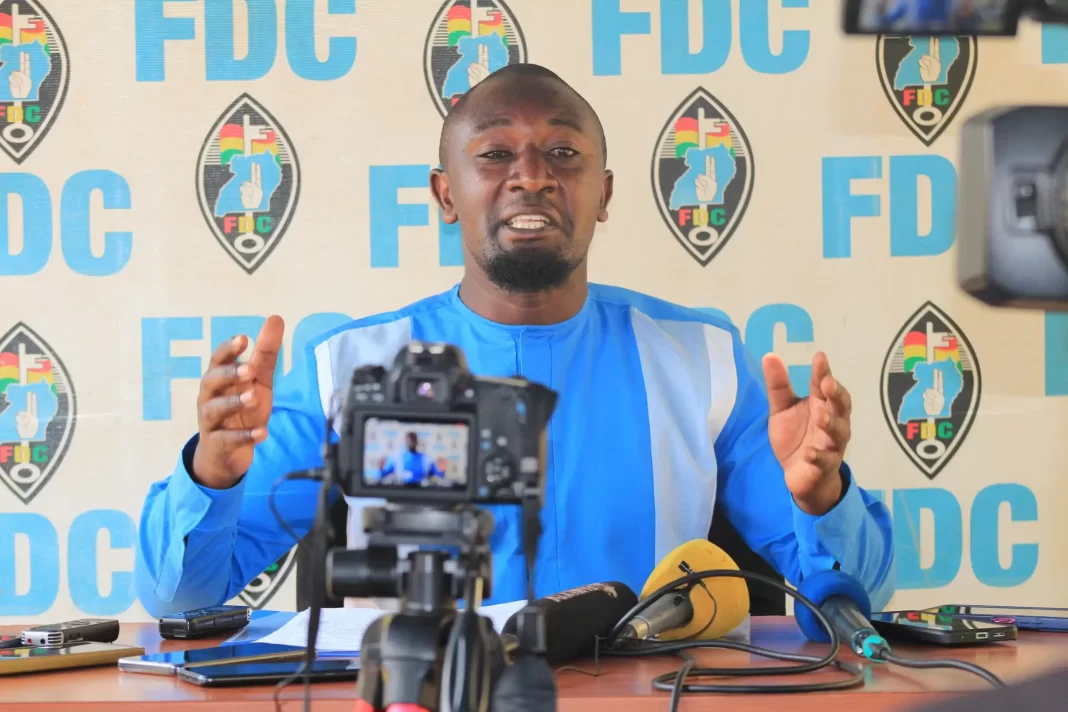
Addressing journalists on Monday, October 5th, 2026, at the party headquarters at Najjanankumbi along Entebbe Road, the FDC Deputy Secretary for Publicity, Mulindwa Walidi Lubega, said the party totally rejects the move, warning it will worsen the already alleged dire teacher shortage in the country.
“Uganda has over 15 million learners and only about 300,000 teachers. The pupil-to-teacher ratio is already 1:58 to 1:60 in many UPE schools, against the recommended 1:45. Closing dozens of colleges and keeping only a few centres will drastically cut annual output. This gap will never be closed if this arrangement is fast-tracked by government,” Lubega said.
Lubega said centralisation will destroy decentralisation and access, noting that PTCs and NTCs were deliberately spread across regions to bring training closer to the people. Centralisation, he argued, will mean long distances, higher costs and locking out poor but talented Ugandans.
He further warned that the policy will kill institutional capacity, citing Kyambogo University (ITEC) as the historical pillar of teacher training. He noted that Makerere and other universities have invested billions in infrastructure for teacher education, and phasing them out is pure wastage and destruction of institutional memory.
On the shift to the Competence-Based Curriculum (CBC), Lubega said the FDC supports CBC in principle but faulted the Ministry for implementing it upside-down.
“You cannot shift learners to CBC while teachers were trained under the old knowledge-based system and have not been retooled. CBC requires facilitators and practical mentors, not teachers from a rushed centralised programme,” he said.
According to Lubega, what is needed is retooling all tutors in CBC pedagogy and aligning the teacher training curriculum itself to CBC so that every trainee from Kabong to Kanungu graduates CBC-compliant, and not closing colleges.
The party has called upon the government to abandon the plan to phase out PTCs, NTCs and teacher training in universities.
“We call upon the Ministry of Education to improve the existing arrangement by designing and enforcing a uniform national curriculum that is aligned to the Competence-Based Curriculum,” Lubega noted.
He added that government should prioritise Continuous Professional Development (CPD) for the over 300,000 teachers already in service who are struggling with CBC, invest in quality teacher education by equipping colleges with labs, ICT and practical facilities, and improve tutors’ welfare and remuneration.
Lubega also demanded that the policy be subjected to wide consultation and public participation involving UNATU, teachers, universities, colleges, parents, students and local governments.
“Uniformity does not need a monopoly. UNEB standardises examinations without closing schools. The Ministry can achieve uniformity through one national curriculum,” he stated.
The party’s rejection of the policy comes as Uganda joins the rest of the world to mark World Teachers’ Day today, October 5 2026, under the theme ‘Standing with teachers: 60 years of protecting the profession, advancing its status and shaping our futures’.