
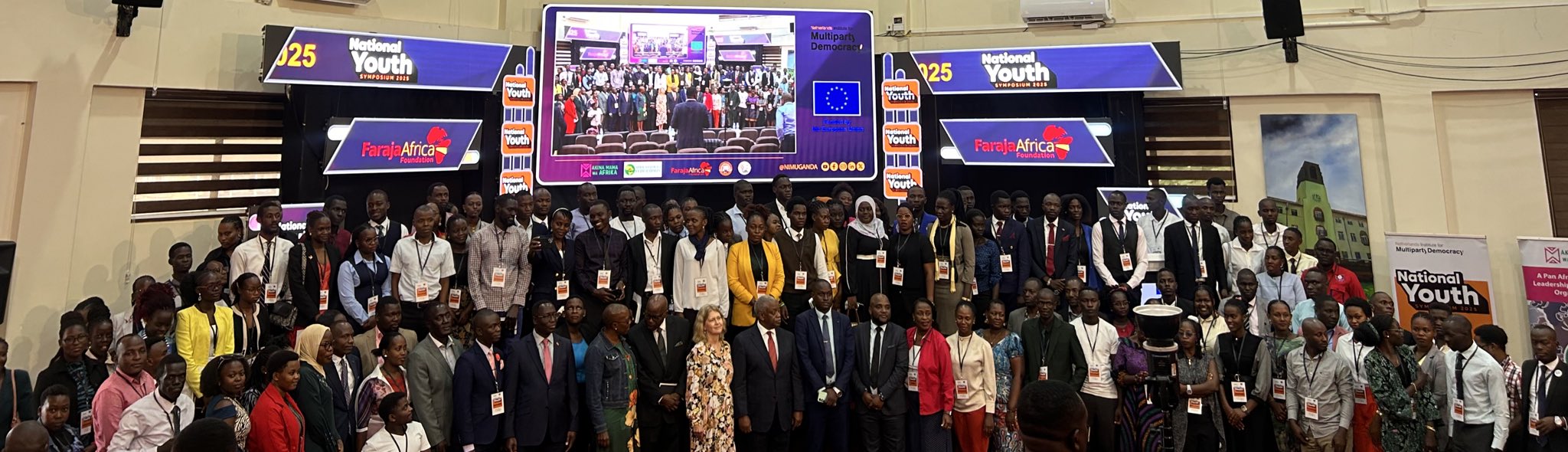
Over 300 young Ugandans converged at Makerere University for the 3rd National Youth Symposium, a vibrant and timely forum commemorating two decades of multiparty democracy in Uganda.
Held under the theme “A Reflection on 20 Years of Multiparty Politics: The Role of Young People in Building a Democratic, United and Prosperous Uganda,” the symposium became a resounding call for youth participation, agency, and visionary leadership in Uganda’s democratic journey.
Organized by the African Youth Federation (AYF) in collaboration with the Netherlands Institute for Multiparty Democracy (NIMD), the Embassy of Sweden, and several civic organizations, the two-day event served as a dynamic space for reflection, engagement, and strategic planning. It brought together students, young political actors, civil society leaders, and policymakers, united in their resolve to reimagine democracy through the lens of Uganda’s majority youth population.
 The symposium opened with a stirring address by Primus Bahigi, Country Director of NIMD Uganda. He urged the youth not to wait for permission to lead, but to assert themselves now. “The time for symbolic representation is over. The future is not tomorrow. It is now,” he declared, ending his remarks with an original and emotionally charged poem titled “The Voice,” which captured the disillusionment and resilience of Uganda’s young people.
Ambassador Maria Håkansson of Sweden reinforced Bahigi’s message, commending Uganda’s youth for their energy and commitment to democratic values. She cautioned against rising global threats to democracy, such as civic space restrictions and political polarization, and encouraged Uganda’s young citizens to lead the charge for accountability and inclusion. “The future of democracy lies in your hands,” she stated.
In a keynote speech rich with personal and political history, former Prime Minister Rt. Hon. Amama Mbabazi offered a candid reflection on Uganda’s democratic evolution—from post-conflict unity under the Movement System to the 2005 restoration of multiparty politics. He emphasized that Uganda’s youth cannot afford to be passive bystanders. Quoting Thomas Sankara, he challenged them: “You must stop being spectators. Become authors of our shared future.”
Mbabazi’s speech called for internal reform in political parties, mentoring young leaders, and institutionalizing ethical, ideology-driven leadership pipelines. He underscored the need for youth to lead not just with energy, but with vision, discipline, and moral courage.
Across multiple panels, both seasoned politicians and emerging youth leaders debated the real value of affirmative action and the future of political inclusion. Questions were asked boldly: Has affirmative action empowered or pacified young people? Are political parties prepared to genuinely open up to new voices?
Speakers such as Hon. Winnie Kiiza, Jacob Eyeru, and Fred Adrico expressed a mix of hope and frustration. Kiiza challenged young leaders directly, saying, “Being young isn’t enough—are you prepared for power?” The panelists agreed that without institutional reform, affirmative action risks becoming performative. They called for practical mentorship structures, political education, and independent youth organizing to reclaim authentic leadership.
Several challenges were identified as core obstacles to meaningful youth participation in Uganda’s democratic system. These included weak internal democracy in political parties, which often limits youth from rising through ranks based on merit. Civic illiteracy and economic disempowerment were also highlighted, leaving many young people unable to meaningfully engage or contest leadership.
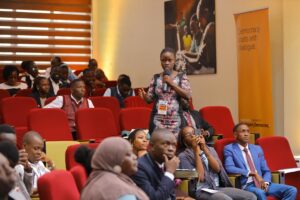
Tokenism in youth leadership roles was a recurrent concern, with participants noting that symbolic positions rarely translate to real influence. Moreover, there was a growing disconnect between elected youth leaders and the communities they represent, weakening the credibility of youth representation.
In response, the symposium produced a robust set of recommendations. Key among them was the creation of structured mentorship and leadership programs within political parties to ensure young leaders are nurtured from the grassroots. Participants also emphasized the need to digitize civic education and leadership training, making it accessible to youth across the country.
A national Youth Progress Index was proposed to monitor and track youth inclusion and representation in governance. Inter-party youth forums and policy labs were recommended to foster innovation and collaboration beyond political divides. Lastly, reforming the education system to better support civic engagement and economic participation was deemed critical for sustainable youth empowerment.
As Uganda approaches the 2026 General Elections and prepares to implement its Fourth National Development Plan, one message rang loud and clear: youth inclusion must move beyond rhetoric. The young generation is not waiting in the wings; they are organizing, learning, and stepping forward to claim their space.
“We’re done waiting to be handed power,” said youth panelist Wacha Elizabeth Shakira. “We’re building it ourselves.”