
Uganda’s Electoral Commission (EC) has confirmed that 21,681,491 people are registered to vote in the 2026 General Elections, with women comprising 53% (11,347,129) and men 47% (10,334,362).
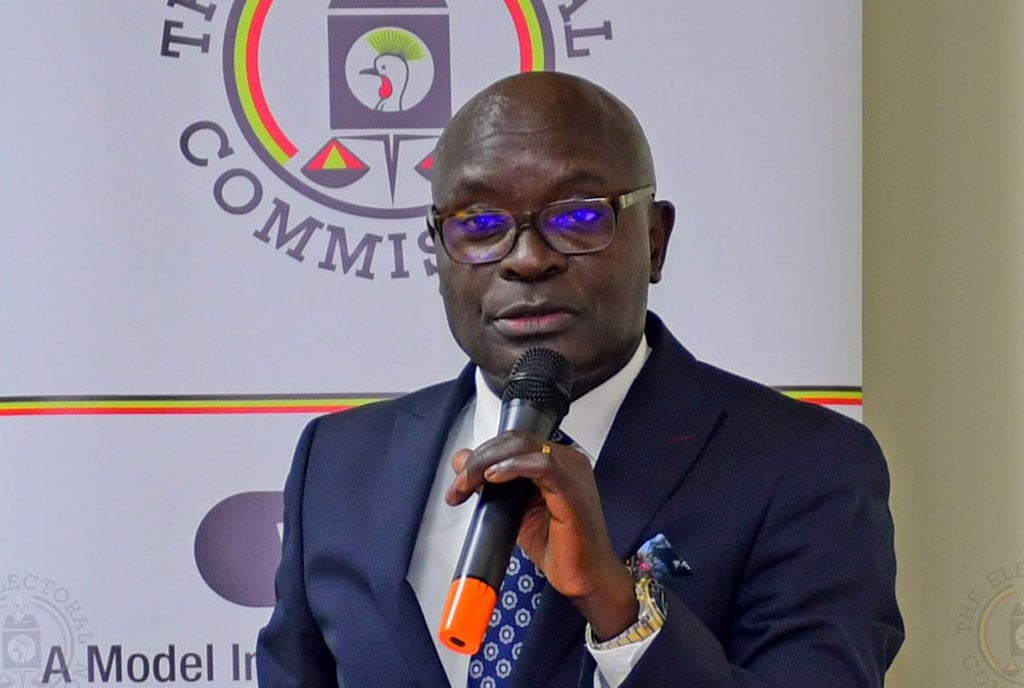
Speaking to journalists on Wednesday, 26th November, 2025, EC Chairperson Justice Simon Byabakama revealed that 83,597 candidates have applied for 45,505 elective positions, ranging from the presidency to Sub County Councilor posts.
He praised the media for keeping the public informed and assisting citizens in making informed electoral choices.
As of 13th November, 2025, statistics show that Uganda has 146 constituencies, 353 sub-counties/towns/municipal divisions, 2,191 parishes, 10,717 villages, 71,214 polling stations, and 50,739 registered voters.
In response to the deaths of seven candidates, fresh nomination exercises have been scheduled for Thursday, 27th November, and Friday, 28th November, 2025, although nominees in the affected positions will not need to re-nominate.
Ballot printing is currently underway, with contracts awarded to companies across several countries which include;
Al Ghurair Printing & Publishing LLC in Dubai is handling Presidential, Parliamentary, and District/City ballots.
UniPrint in South Africa is printing Sub-County, Town, and Municipal Division Chairperson ballots, while Inform Lykos in Greece is responsible for Sub-County, Town, and Municipal Division Councillor ballots.
Sintel Security in Kenya is producing Special Interest Group Councillor ballots, and Picfare Industries & Graphics Systems in Uganda is printing Municipality and City Division ballots.
The EC has also acquired 109,142 upgraded Biometric Voter Verification Kits (BVVKs) for all polling stations, with 60,000 already delivered. These devices, equipped with fingerprint and facial recognition, aim to enforce the ‘One Person, One Vote’ principle.
According to Byabakama, 60,000 kits have already been delivered, with the remaining 49,142 expected by the end of the month.
Recruitment of operators and trainers is underway, alongside public demonstrations to familiarize voters with the technology.
Political parties contesting in the presidency election have been directed to provide nominees who would act as agents in the process of voting.
The polling calendar has been scheduled as follows.
Presidential and Members of Parliament elections will take place on 15th January 2026.
Elections for Persons with Disabilities, Youth, and Older Persons at the Sub-County level are set for 19th January, followed by Municipality and City Division Special Interest Group elections on 20th January.
Workers’ Representatives to Parliament will vote on 21st January, while District and City Chairpersons and Councilors will go to the polls on 22nd January.
Municipality and City Division Chairpersons and Councilors elections are scheduled for 27th January, with National Female Youth and Older Persons, as well as UPDF Representatives, voting on 28th January.
District and City Special Interest Group elections will be held on 29th January.
Regional Older Persons to Parliament will vote on 2nd February, Sub-County, Town, and Municipal Division Chairpersons and Councillors on 4th February, and Regional Youth to Parliament elections will conclude the cycle on 6th February.
Byabakama praised candidates adhering to campaign guidelines but condemned violations such as unscheduled rallies, defamatory speech, poster destruction, and violence.
“The Commission will not hesitate to apply sanctions against any individual or political party that violates the campaign guidelines,” he warned, noting that over 300 petitions mostly nomination-related have been resolved on merit.
He urged everyone to uphold peace and act responsibly, emphasizing that ensuring a credible electoral process is a collective duty.
“Ensuring a credible election is a responsibility we all share. I call on every stakeholder to act peacefully and uphold the law,” the EC Chairperson emphasized.
As the nation prepares to head to the polls, all stakeholders are reminded that the integrity of the elections depends on their cooperation, civility, and respect for democratic norms.