
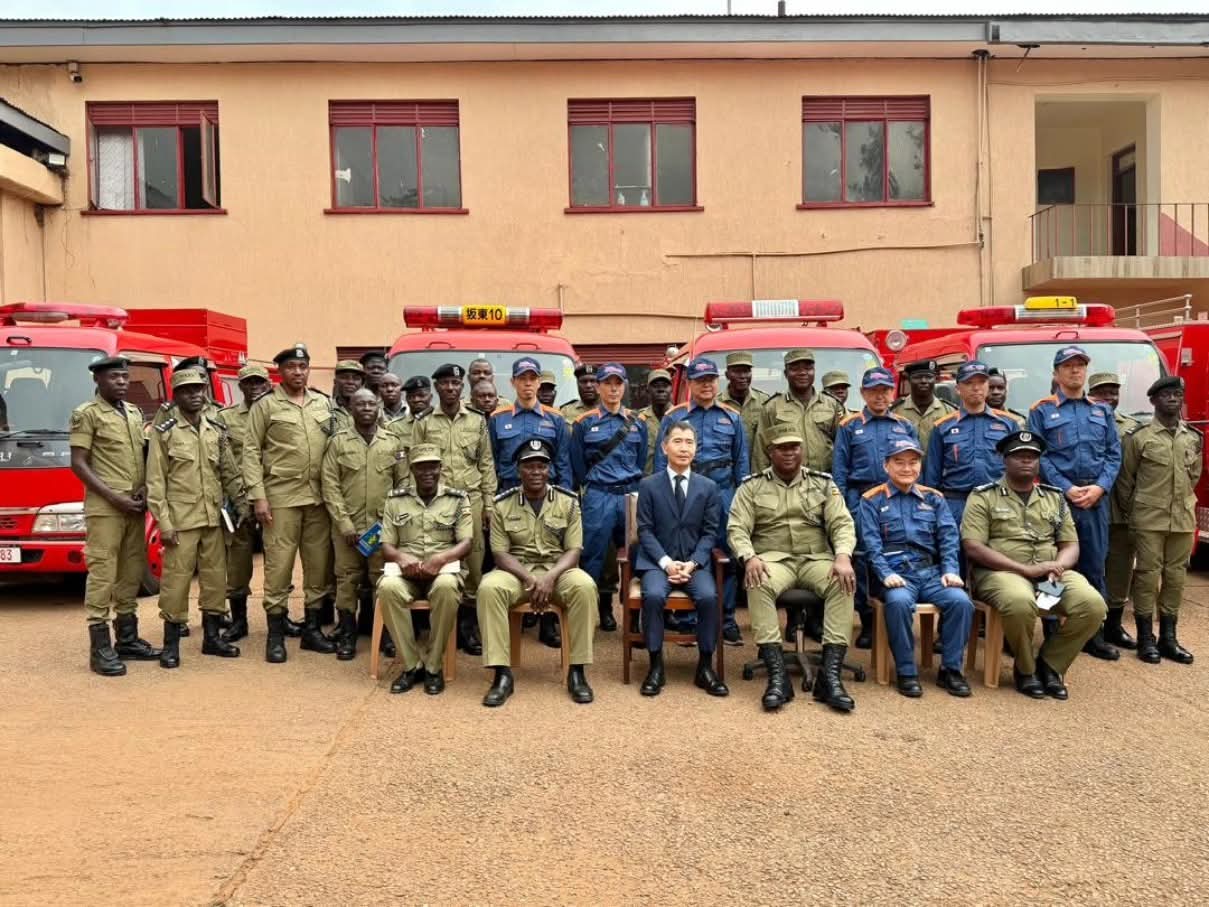
More than 50 officers from the Directorate of Fire and Rescue Services have embarked on a five-day capacity-building program aimed at improving the operation and maintenance of firefighting vehicles.
The training, which began on 10th December, 2025 at the Fire Brigade Headquarters in Kampala, marks a significant step in strengthening the Uganda Police Force’s emergency response capabilities.
It was officially launched by the Deputy Head of Mission at the Embassy of Japan, Norimasa Yoshida, alongside AIGP Moses Kafeero, the Director of Human Resource Development.
A team of Japanese specialists will guide the officers throughout the specialized program, sharing technical expertise and practical knowledge.
Addressing the officers, AIGP Kafeero emphasized the importance of equipping officers with practical skills that match the complexity of modern firefighting machinery.
“This training is not just a routine exercise; it is an investment in safety, efficiency, and professionalism,” AIGP Kafeero said.
“Our officers are at the forefront of protecting lives and property, and to perform effectively, they must have the skills and confidence to operate and maintain these vehicles at the highest standard,” he added.
The curriculum covers essential skills such as vehicle maintenance, safe handling, and optimal operation of firefighting trucks and this knowledge is considered crucial for ensuring the longevity and reliability of the fleet.
Japan’s Embassy Deputy Head of Mission, Yoshida, highlighted Japan’s commitment to supporting Uganda’s emergency services through both equipment and expertise.
“Strong disaster-response systems begin with well-trained personnel and our partnership with the Uganda Police Force reflects our long-term dedication to building safer communities,” he stated.
This collaboration follows Japan’s donation of 19 emergency vehicles to the Uganda Police Force, including 16 fire trucks, a command van, a rescue vehicle, and an ambulance.
Officials say the training complements these contributions by equipping officers with the technical expertise needed to maximize the utility of the advanced equipment.
For participants like Odong Martin, the training is both timely and essential.
“We use these trucks every day, but understanding their systems deeply helps us respond faster and avoid breakdowns. This knowledge will make our work safer and more effective,” he said.
By the end of the five-day program, the Directorate of Fire and Rescue Services expects that the enhanced skills and technical knowledge gained by the officers will translate into faster, more efficient emergency responses, better-maintained equipment, and stronger overall service delivery, eventually contributing to safer communities across Uganda.