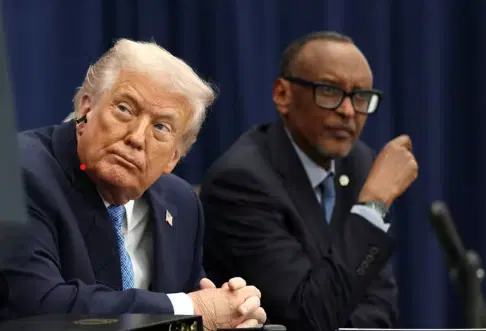
Fresh sanctions by the United States Department of the Treasury against the Rwanda Defence Force (RDF) have exposed widening diplomatic fractures in the Great Lakes region, as Kigali and Kinshasa harden their positions over the escalating conflict in eastern Democratic Republic of the Congo (DRC).
The measures, announced on March 2, 2026, target the RDF and four senior Rwandan military officials over alleged support to the March 23 Movement (M23), which continues to battle Congolese forces in North and South Kivu despite the December 2025 Washington Accords for Peace and Prosperity.
The Government of Rwanda swiftly rejected the sanctions, branding them “one-sided” and accusing Washington of distorting the realities on the ground.
In a statement from Kigali, Rwanda argued that the U.S. action unfairly isolates one party to the peace framework while ignoring what it describes as hostile armed actors operating along its borders.
“The sanctions unjustly target only one party to the peace process and misrepresent the reality of the conflict,” Rwanda’s spokesperson said, insisting that national security concerns remain paramount.
Kigali further warned that sustainable peace cannot emerge from what it termed “selective accountability,” signaling that it views the sanctions as diplomatic pressure rather than neutral enforcement of the accord.
U.S. officials framed the move as part of a broader strategy to enforce compliance with the peace deal.
Thomas Pigott of the United States Department of State said Washington would use all appropriate tools to hold accountable actors undermining stability in eastern Congo.
Treasury Secretary Scott Bessent underscored the deterrent message behind the sanctions, warning that material support to armed groups would carry consequences.
The sanctions mark one of the most direct U.S. actions against Rwanda in recent years, potentially reshaping diplomatic alignments in Central and East Africa.
In Kinshasa, the sanctions were welcomed as a diplomatic victory. The DRC government described the measures as a reaffirmation of international support for Congolese sovereignty and territorial integrity.
The divergent reactions highlight the fragile state of the Washington Accords, negotiated under U.S. mediation to halt hostilities and establish a roadmap for lasting peace between Kigali and Kinshasa.
Months after the agreement, clashes continue in parts of North and South Kivu, with humanitarian agencies reporting worsening displacement.
Beyond the immediate diplomatic exchange, the sanctions risk deepening mistrust in a region already scarred by decades of cross-border tensions, mineral competition, and proxy armed movements.
For Rwanda, the issue is framed as existential security. For the DRC, it is a question of sovereignty and territorial control. For Washington, it is a test of whether international mediation backed by economic pressure can compel compliance.
As fighting persists and accusations mount, the central question now is whether sanctions will deter escalation or entrench hardened positions further.