President Yoweri Kaguta Museveni has endorsed a new uniform cattle restocking plan for the Teso sub-region, calling recommendations from a recent consultation report realistic, inclusive, and transformative.
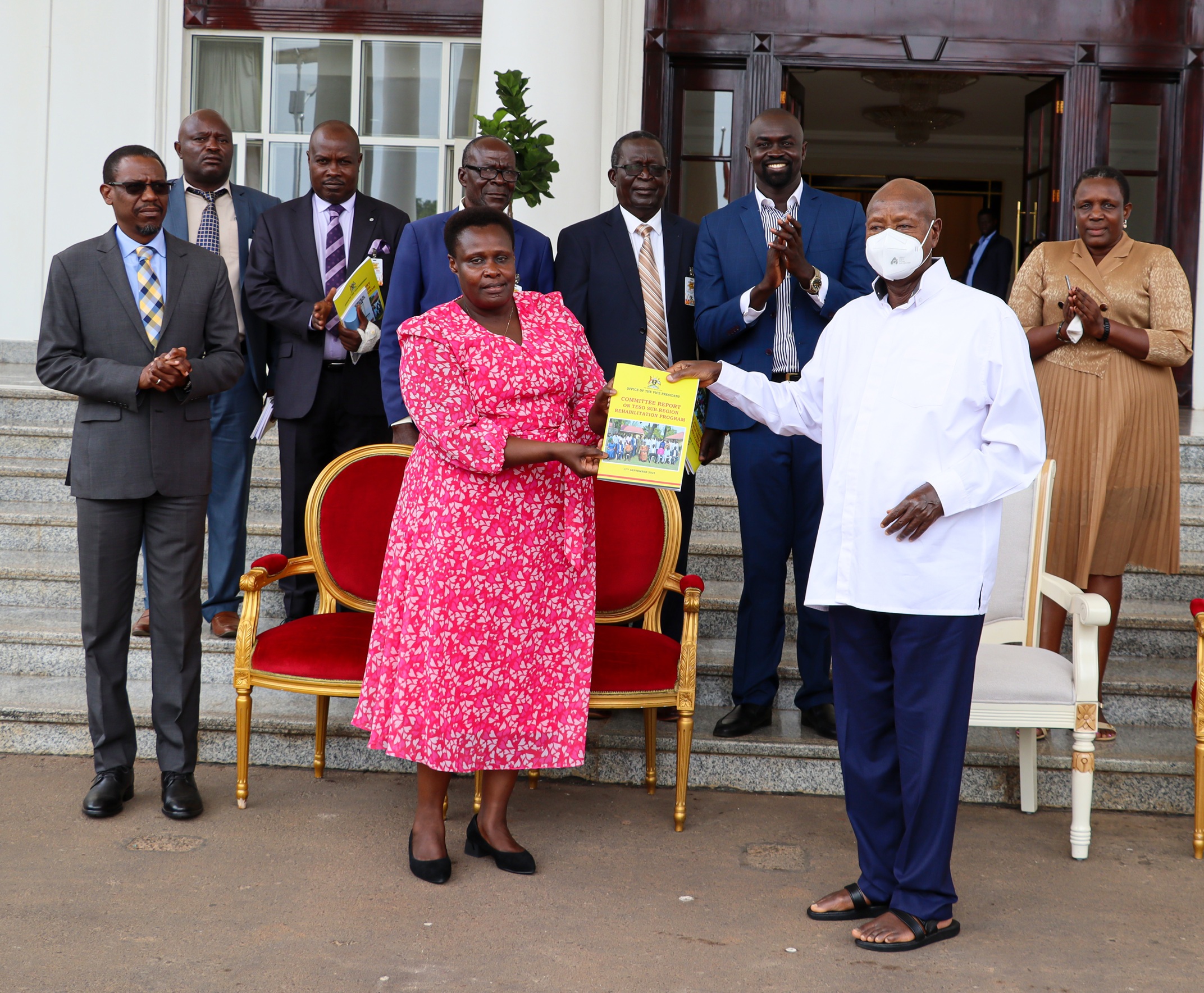
The President made the remarks on Wednesday, 17th September, 2025, during a meeting at State House, Entebbe with a committee led by Vice President Jessica Alupo.
The team, which included Members of Parliament, cultural leaders, and religious figures, had conducted extensive consultations across Teso to address long-standing concerns over corruption and inefficiency in the ongoing cattle compensation program.
“I’m very happy with the substance of the report because it’s more realistic, all-inclusive, and transformative,” Museveni said. “The other format was wasting a lot of resources and excluding many people. We shall discuss this report in Cabinet and also listen to what the people of Lango and Acholi are saying.”
The committee’s report, presented by Hon. Bosco Okiror, MP for Usuk County, recommended a uniform restocking package of five cows per household across Teso.
The sub-region has about 489,000 households in 12 districts, according to the 2024 National Population and Housing Census.
Households that prefer cash could instead receive the equivalent of five cows, valued between UGX 1.5 million and UGX 2 million per cow, to be managed at sub-county level. This option, Hon. Okiror explained, would allow families to make their own livestock purchases.
President Museveni welcomed the plan but stressed the importance of addressing polygamous households fairly.
“I would be comfortable with each male-headed unit, whether polygamous or not, first getting their share. Once the cows multiply, those families will be agents of change,” he noted.
The President also clarified that Butebo and Pallisa districts, which had petitioned for inclusion in the program, would be considered separately.
During the meeting, Museveni responded to grievances from Teso residents regarding the presence of Balaalo herders in the sub-region.
“They should go. I solved this problem long ago. They have no good reason to stay in those areas illegally,” he said, emphasizing the need for lawful procedures to protect both communities and livestock.
Vice President Alupo reported that the consultations were comprehensive and peaceful, with cultural leaders playing a central role in shaping the recommendations.
“All the people of Teso unanimously supported the restocking program for every household. Everybody was thanking you for appreciating that all people deserve to be empowered with a uniform formula,” she told the President.
Cultural leaders, including His Highness Emorimor Paul Sande Emolot of the Iteso and Papa Kumam Raphael Otaya of the Kumam, thanked the President for involving traditional institutions in national development.
They pledged continued cooperation to promote social and economic transformation.
The meeting was also attended by Attorney General Kiryowa Kiwanuka, alongside other political and religious leaders from Teso.
The engagement followed high-level meetings in August 2025 across Teso, Lango, and Acholi, where Museveni urged communities to select trustworthy representatives to design a fair and transparent compensation framework.
The cattle compensation program, launched in March 2022 with a budget of UGX 200 billion, was established to compensate victims in Acholi, Lango, and Teso who lost livestock and property during past insurgencies and cattle raids.
President Museveni has emphasized that the initiative is an exceptional peace and recovery measure, not a routine government program.
He reaffirmed his commitment to implementing the committee’s recommendations, ensuring that compensation reaches all households fairly and transparently.
With his endorsement of the uniform restocking plan, President Museveni signaled a decisive step toward resolving long-standing grievances in Teso while reinforcing trust in government-led recovery efforts.
By committing to fairness, inclusivity, and transparency, the program is set not only to restore livelihoods but also to strengthen social cohesion and accelerate the region’s journey toward peace and economic transformation.