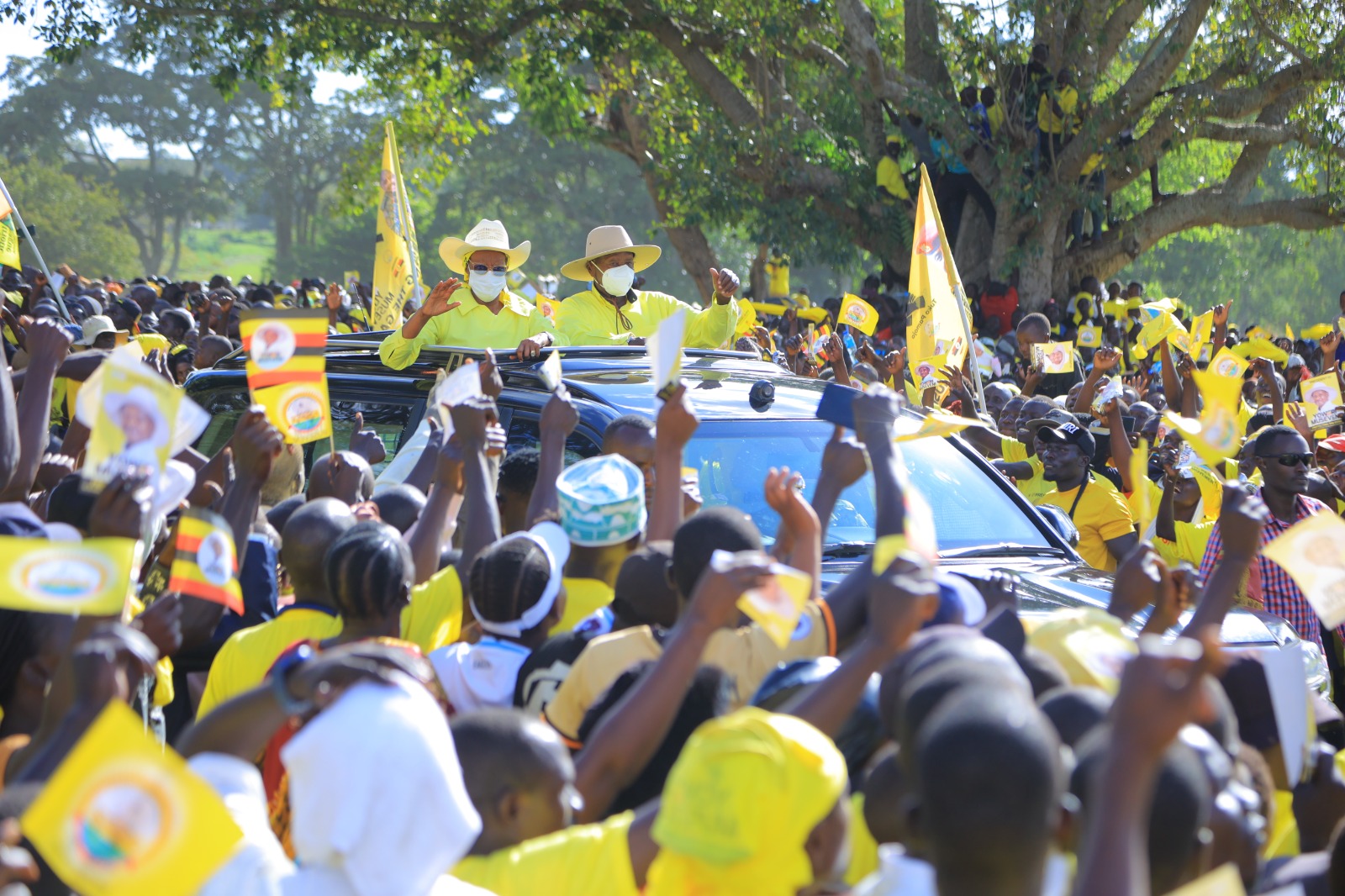
President Yoweri Kaguta Museveni, who is the National Resistance Movement party Presidential flag bear has intensified his campaign strategy in West Nile firing the region with strategic messages aimed at boosting development and wealth creation in the area.
On Monday, 12th October, 2025, President campaigned in Arua City and Madi-Okollo District where he highlighted strong signal regarding his well laid plans to deliver the region fully into the money economy, and emphasized agriculture, trade, and local empowerment.
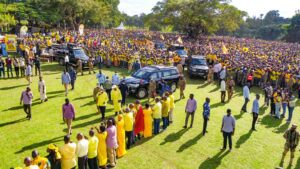
In both rallies, thousands of local people dressed in yellow T-shirt fired energized excitement and happiness while attending Museveni’s addresses.
West Nile has historically been a complex electoral battleground; it once produced presidents (Obote and Amin), endured rebellion, and later emerged as a crucial swing region.
In Arua, Museveni positioned the NRM as the antidote to Uganda’s past instability, reminding voters that pre-1986 politics of tribe and religion destroyed the country.
“We built a national party that unites Ugandans regardless of tribe, religion, or gender.”
This message resonates deeply in West Nile, a region once marginalized and politically fragmented. By framing the NRM as the guarantor of national belonging, Museveni redefines loyalty not as political transaction, but as historical responsibility.
Museveni used education statistics to show progress where he indicated that a total of 120 government primary schools in Arua District/City, and 16 government secondary schools have been built.
He contrasted this with the 1960s when there was not a single A-Level school in the entire Northern or Eastern Uganda.
In Arua City, Museveni emphasized new tarmac roads, power extension projects, planned industrial growth and in Madi-Okollo, the President pledge massive road upgrades to boost agricultural markets, extension of health and education facilities and integration into regional trade corridors.
One of Museveni’s most strategic wins in Arua was the defection of over 300 NUP supporters, led by former student leader Alionz Lawrence Dangote.
In Madi-Okollo, NRM also activated local UPC and independent mobilisers to create multi-party backing for Museveni, weakening the narrative of regime isolation.
Arua leaders used the campaign to table demands where they asked for more administrative divisions (currently overstretched), upgrade Arua Hospital to National Referral status and convert Arua Airstrip into an international airport
President Museveni welcomed the proposal and pledged to support it , turning local dissatisfaction into political negotiation rather than opposition fuel.