
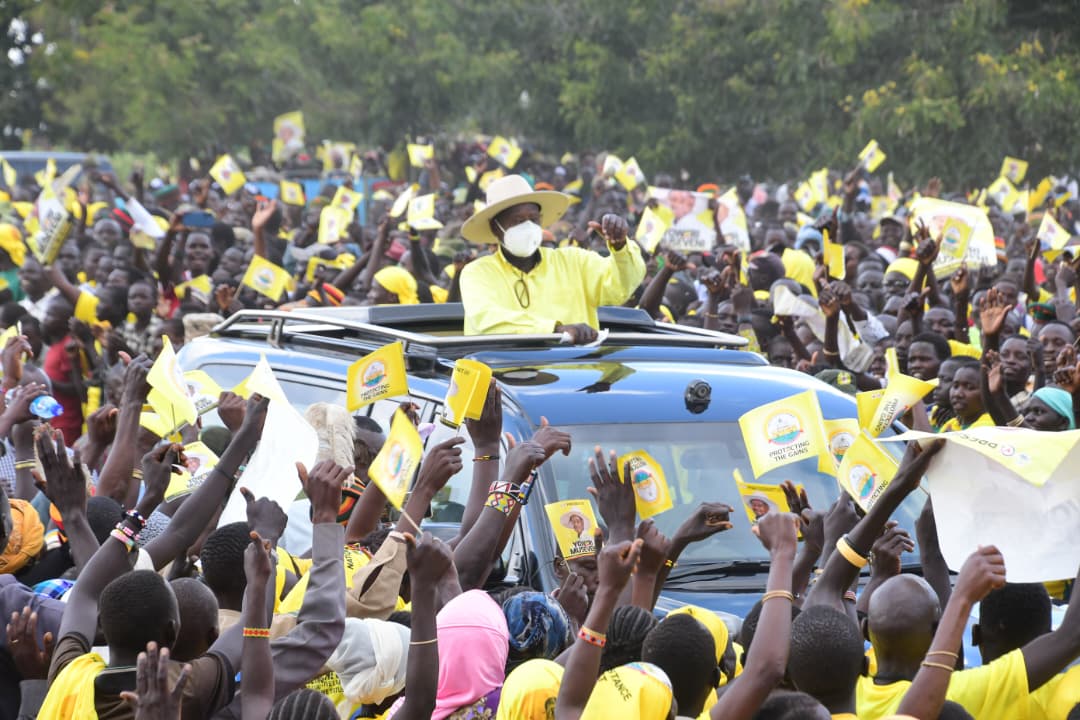
President Yoweri Kaguta Museveni has turned the spotlight on Karamoja, portraying it as a living symbol of Uganda’s transformation from conflict to stability, as he rallied thousands in Karenga and Kaabong districts with a powerful message of peace, wealth creation, and regional integration.
Addressing a mammoth crowd at Jubilee 2000 Secondary School in Karenga District on Saturday, 25th October, 2025, Museveni recounted the hard-fought journey that turned the once-volatile region into a zone of peace, saying his government’s strategic disarmament and mindset change campaigns were the cornerstones of Karamoja’s revival.
“Many of our people were misled to believe that stealing cows was bravery. But I had to show them that true strength is in building a future not in carrying a gun,” Museveni said.
Museveni revealed that the campaign to persuade the karacunas the young Karamojong warriors to abandon cattle rustling was one of the most difficult but rewarding missions of his presidency.
He praised the role of local youth leaders, women activists, religious groups, and the army, who worked tirelessly to bring the young raiders home from South Sudan and Ethiopia.
The president met several reformed warriors and took them to other parts of Uganda to witness how peace had transformed lives.
A short clip of President Museveni’s arrival at Kaabong SS Grounds in Kaabong town. Clip by Ronald Odongo.
“When they came back, they told others what they had seen, and slowly, the message spread that there is a better life beyond cattle raids,” he said.
Museveni also dismissed critics who argued that disarmament could not succeed unless neighboring communities like the Turkana and the Ethiopians were also disarmed.
“I told them, I am not here to disarm the whole of Africa. I will disarm my citizens, and if the others come to steal, we shall deal with them,” he said to thunderous applause.
Analysts say Museveni’s remarks reflect his long-standing doctrine of internal stabilization first, a principle that has guided Uganda’s security policy since the 1980s.
The President attributed Karamoja’s gradual development to peace, noting that once the guns fell silent, government could finally extend key infrastructure roads, electricity, schools, and clean water.
“When I first came here in 1980, Karamoja had only 190,000 people. Many were dying from raids and diseases. Now, the population is growing because there is peace, and people are working,” Museveni said.
Museveni’s strategy now focuses on converting peace into prosperity, encouraging residents to embrace commercial agriculture and modern livelihoods. Using the success of other regions in the cattle corridor as examples, he emphasized that Karamoja too can become an economic hub.
In Kaabong District, Museveni was met by a sea of supporters who echoed his message of peace but also raised long-standing concerns from delayed livestock compensation to poor road networks and the continued detention of youth linked to past cattle raids.
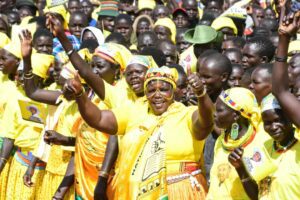
A group of Peace promoters in Karamoja region dancing after the rally at Kaabong SS grounds.
The President promised that these concerns would be addressed in the next phase of his government’s development plan.
“Peace alone is not enough. We must now add wealth, infrastructure, and justice,” he said.
President will on Monday campaign in Kotido and Moroto districts.