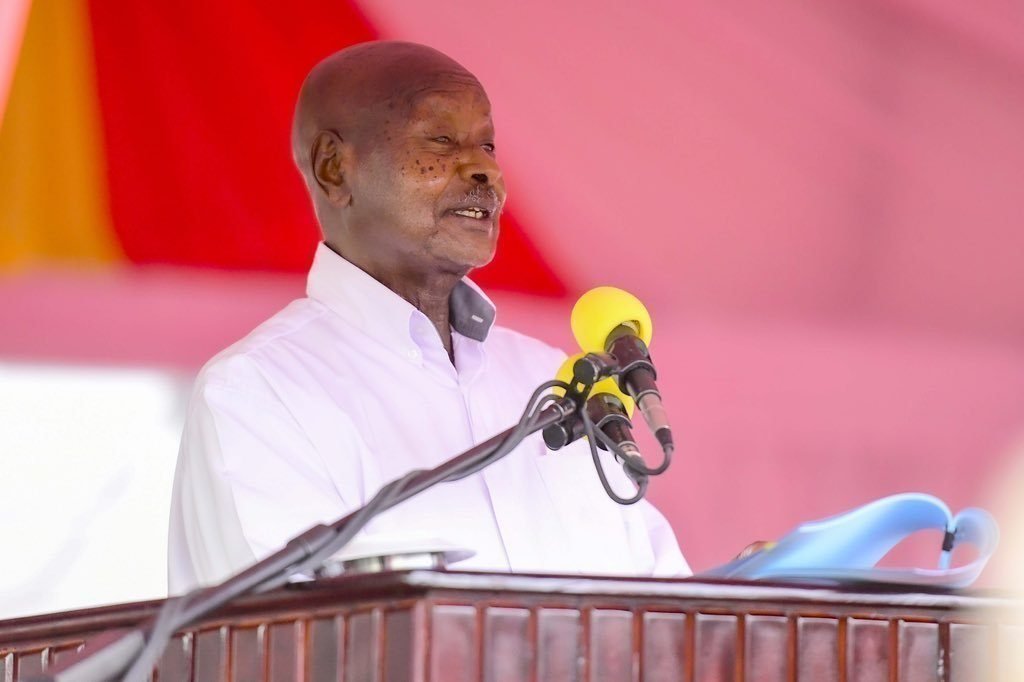
President Yoweri Kaguta Museveni has criticized commercial banks for encouraging dependency and hindering business growth in Uganda by charging high and unreasonable interest rates.
Speaking at the inaugural Uganda Development Finance Summit at the Commonwealth Resort in Munyonyo on Monday, September 1, 2025, the President said interest rates over 20 percent are preventing Ugandans from making productive investments.
“How do you lend at 22 percent per annum when inflation is below 5 percent? At such rates, people cannot do serious business; they can only engage in quick import trade of perfumes and wines. These banks are engines of Africa’s dependence,” Museveni remarked.
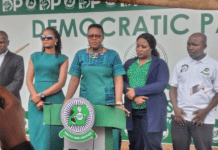
The President, joined by the First Lady and Minister of Education and Sports, Janet Kataaha Museveni, specified the need for patient capital through the Uganda Development Bank (UDB).
He emphasized that UDB is meant to support sectors that create real wealth. “Our answer was UDB, a government institution that is not focused on profit but provides capital for infrastructure and wealth creation. Wealth is personal, but development is collective. Development is for everyone, including the drunkards and the witch doctors. But wealth comes from agriculture, manufacturing, services, and ICT,” he explained.
He also pointed out Africa’s failure to fully utilize its resources, using Uganda’s coffee as an example. “You produce a kilo of coffee and get $2.5. Somebody processes it into Nescafé and sells it for $40. Who is the donor? You are the donor, but you don’t know,” he observed.
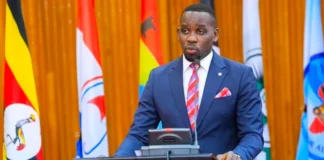
The Minister of Finance, Hon Matia Kasaija, said Uganda is on track for rapid economic growth, with GDP expected to rise tenfold in the next 15 years.
“Africa has immense potential and is poised to grow faster than most regions of the world. Uganda grew at 6%, compared to a world average of 2.7%. Our GDP, nearly $50 billion in 2023, will rise to $500 billion by 2040, anchored on agro-industrialization, tourism, mineral development, oil and gas, and ICT innovation,” Kasaija said.
He stressed that UDB remains critical to unlocking finance for these anchor sectors.
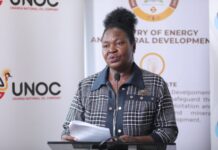
Dr Patricia Ojangole, Managing Director of UDB, argued that national development banks are indispensable for channeling funds into productive sectors ignored by commercial lenders.
“Development finance institutions have propelled transformation globally. Asia’s rise and Brazil’s growth are credited to strong national development banks. Uganda was visionary in keeping UDB alive when others closed theirs during structural adjustment,” Ojangole said.
She revealed that while commercial banks direct nearly half of their credit to non-productive areas like real estate, UDB allocates over 80% of its portfolio to agriculture, manufacturing, energy, education, and health.
“With climate change, digital transformation, and shrinking fiscal space, the role of NDBs is greater than ever. We must use blended finance, support digital infrastructure, and develop pipelines of bankable projects,” she added.
Mr. Geoffrey T. Kihuguru, Chairman of the UDB Board, said development banks must rise to Africa’s pressing demographic and structural challenges.
“We meet at a time of overlapping crises, geopolitical tensions, disrupted value chains, and climate change. Yet Africa faces the urgent task of creating jobs for its youthful population. Development banks, working with DFIs, are uniquely placed to design instruments that expand inclusion, finance underdeveloped regions, and drive industrialization,” he said.
In his closing remarks, Museveni stressed that Africa’s transformation needs two key elements: vision and integrity. He warned that without true market integration, the continent risks repeating Latin America’s fragmented path.
“As a strategist, I can tell you that integrating the African market is a matter of life and death. Without a large market, you cannot grow. Latin America has everything—minerals, water—but it remains poor because of market fragmentation,” he said.
The summit, organized by UDB, brought together policymakers, financiers, private sector representatives, and international partners to discuss how development finance can promote Africa’s social and economic transformation.