
President Yoweri Museveni has called for a continent-wide policy to end the export of unprocessed raw materials, arguing that Africa will not achieve meaningful economic transformation unless it shifts from supplying primary commodities to manufacturing finished products.
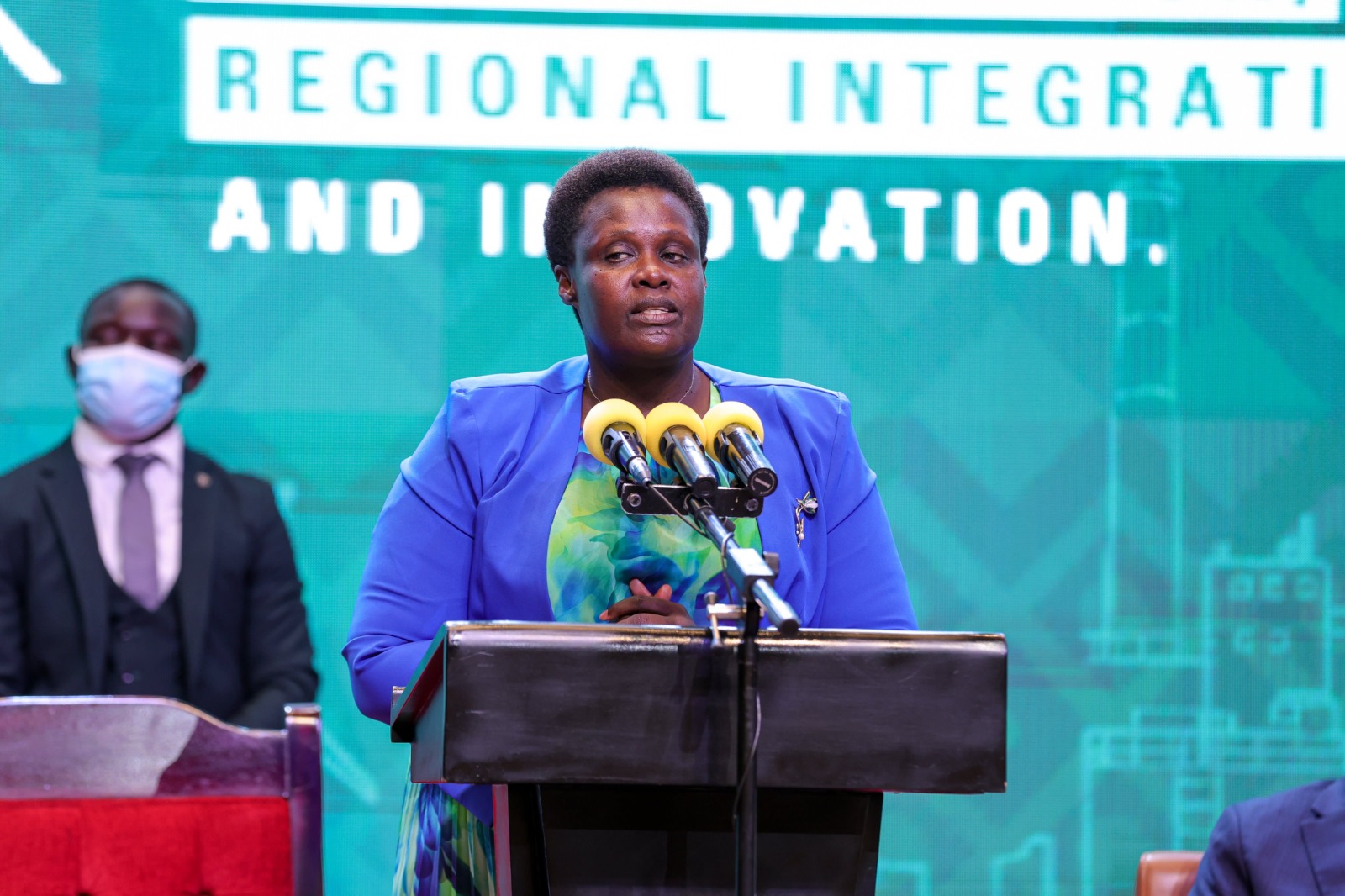
Delivering his speech through Vice President Jessica Alupo at the 2025 edition of the Africa Industrialisation Week at Speke Resort Munyonyo, the President said the continued export of raw materials while importing finished goods made from the same resources is one of Africa’s biggest economic contradictions.
Museveni said history has shown that industrialization is the foundation of national prosperity. He cited the industrial revolutions in Britain, Europe, the United States, Japan and the Asian Tigers, followed by China over the last 50 years, noting that African countries cannot remain spectators.
He pointed out that Africa’s economic output remains disproportionately low compared to the rest of the world.
“In 2024, Africa’s GDP was estimated at USD 2.8 trillion, while the USA had USD 29.81 trillion, China USD 18.74 trillion and Europe USD 19.99 trillion. This needs to be addressed by this conference,” he said.
According to the President, Africa’s industrial sector contributes only 10.4 percent of the continent’s GDP, with the manufacturing share standing at just 2 percent globally. The sector is dominated by low-value products such as food items, textiles, wood, beverages and a growing cluster of medium-technology goods.
Despite these figures, Museveni said Africa possesses unmatched natural wealth.
“Africa is very rich in natural resources with a vast array of minerals including agricultural and raw materials. We have up to 85 percent of the world’s platinum reserves, 90 percent of chromium, 40 percent of gold, 75 percent of phosphate reserves and about 60 percent of the world’s arable land,” he noted.
However, he expressed concern that the continent continues to export these resources in raw form while importing machinery, electronics, vehicles, chemicals and even food products such as rice, cereals and pharmaceuticals goods that Africa has the potential to produce.
Museveni said the African Union Agenda 2063 calls for a decisive shift from primary commodities to value-added products.
“We now have a great opportunity in the coming decade, 2026–2035, which was declared a Fourth Industrial Development Decade for Africa,” he said.
He urged African governments to strictly enforce value-addition policies that prohibit the export of unprocessed raw materials and emphasised that the private sector must be allowed to lead industrial growth.
He further called on the African Continental Free Trade Area (AfCFTA) Secretariat to accelerate the removal of non-tariff barriers that restrict intra-African trade.
Museveni also emphasized that AfCFTA gives Africa a strong foundation for industrial development. With a population of 1.56 billion people as of November 2025, he said the continent has a viable market capable of supporting large-scale industries.
The President reflected on Uganda’s own economic journey, recalling that the country’s economy was in ruins in 1986, with no foreign exchange, no industries and a collapsed private sector.
He attributed Uganda’s recovery from USD 4 billion in 1986 to USD 61.3 billion in 2024/2025 to peace, a correct ideological diagnosis, private-sector-led growth and deliberate investment in value addition.
“Let us build a new Africa based on production, export orientation, regional integration and innovation,” he said.
This year’s Africa Industrialization Week was held under the theme, “Transforming Africa’s Economy Through Sustainable Industrialization, Regional Integration and Innovation.”