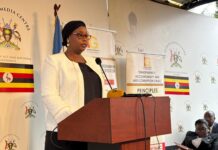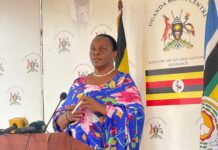
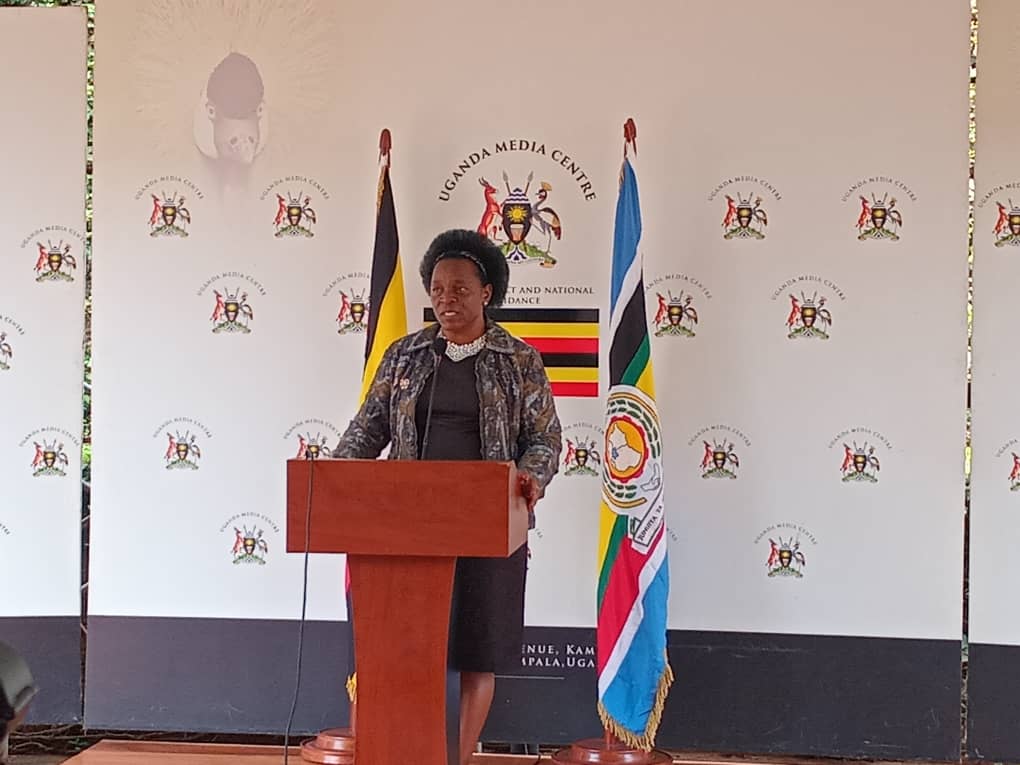
As Uganda heads into the election season, Hon. Peace Regis Mutuuzo, Minister for Gender, Labour and Social Development and Woman Member of Parliament for Bunyangabo district, has called for peaceful coexistence, tolerance, and respect among political players and citizens.
Speaking at the Uganda Media Center in Kampala, on 16th October, 2025, Mutuuzo emphasized that peaceful engagement is essential for sustaining democracy and ensuring inclusive participation.
“We must embrace peaceful coexistence as we approach the elections. Democracy thrives where there is peace, respect, and tolerance, not hostility and intimidation,” the Minister said.
She also reflected on the historical struggle of women in Uganda’s political sphere, noting that women were largely marginalized and excluded from leadership for decades.
“In 1966, Uganda had only four female ministers. Women’s voices were largely missing from national decision-making spaces,” Mutuuzo recalled.
She credited the National Resistance Movement (NRM) government for promoting women’s political empowerment through constitutional reforms, including Article 35, which domesticates the Beijing Platform for Action.
This policy ensures that at least 30 percent of elective positions at local, district, and parliamentary levels are reserved for women.
Mutuzo said the results of these reforms have been remarkable, with the number of women in politics steadily increasing over the years.
“Over the years, women’s participation in Uganda’s political landscape has grown steadily; from 18 percent in 2001, to 29 percent in 2006, 31 percent in 2016, and reaching 35 percent by 2020,” the Gender, Labour and Social Development Minister revealed.
Despite these gains, she expressed concern over stagnation in women’s participation in recent years, attributing it to social and structural barriers.
“The gains made through affirmative action have unfortunately created the perception that women only belong to reserved seats, while open positions are off-limits. That mindset is a form of violence and discrimination we must address,” she stated.
Mutuuzo further noted that cultural and religious norms continue to hinder women’s involvement, with some communities requiring women to seek spousal permission to participate in political activities, and certain religious beliefs portraying women as unfit for leadership.
“In some religions, women are still viewed as unholy or unfit for leadership. These perceptions undermine the very essence of equality and empowerment.” the Minister noted.
She also highlighted financial constraints as a key barrier preventing women from fully participating in political contests and called on institutions to provide support to bridge this gap.
“I call on the Electoral Commission to ensure women candidates have fair and equal opportunities, and urge IPOD to actively promote and support women’s participation in political parties,” she stated.
The minister concluded by reaffirming the government’s commitment to fostering peace, equality and women empowerment as Uganda prepares for the elections.
“As we move towards the election period, let us choose dialogue over confrontation and inclusion over division. Women’s empowerment is not a favor, it is a constitutional right and a pillar of sustainable democracy,” Mutuuzo noted.
Her call serves as a reminder that inclusive participation, respect for constitutional rights, and support for women leaders are essential for a peaceful, fair, and representative political process.