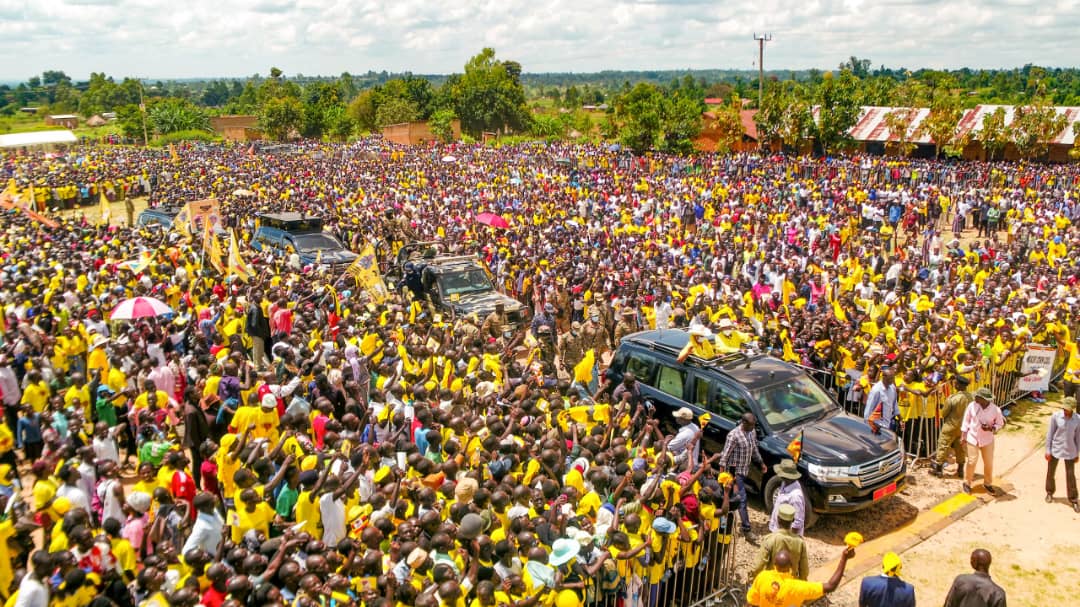
Thousands of National Resistance Movement (NRM) supporters have gathered at Nyadri Urban Secondary School in Maracha district today, on 14th October, 2025, to welcome President Yoweri Kaguta Museveni and First Lady Janet Museveni, as the President continues his 2026 campaign.
The event comes at a time of significant socio-economic transformation in the district, where investments in education, health, water, energy, and infrastructure are reshaping local livelihoods.
Located in Uganda’s northwestern West Nile sub-region, Maracha District is home to 234,712 residents spread across 19 sub-counties/town councils, 91 parishes, and 691 villages.
The district’s voter base has grown steadily, with 111,796 registered voters in 2025, up from 101,182 in 2021. Correspondingly, the number of polling stations increased from 202 to 274 to accommodate the growing electorate.
Below are some of the achievements Maracha has achieved in various sectors.
Maracha District has made notable progress across multiple sectors, reflecting the impact of sustained government investment and development initiatives.
The Parish Development Model (PDM). Since its introduction, Maracha has received UGX 27.95 billion under the program, with 98.66% already disbursed to 30,695 households.
“The government’s continued investment in Maracha through the PDM is transforming lives. Over 30,000 households have benefited, and we are committed to reaching those still waiting,” Collins Dramani, the Maracha Assistant RDC said.
Currently, 15,781 households, including those engaged in the money economy, are yet to benefit from the program.
Education remains a central priority for the district.
Maracha hosts 62 government primary schools and 25 private primary schools, alongside seven government and seven private secondary schools. All government secondary schools offer Universal Secondary Education (USE) and Universal Post Ordinary Level Education and Training (UPOLET), serving 3,276 students.
In addition, the district is constructing two Seed Secondary Schools, reducing the number of sub-counties without a government secondary school from 12 to 10.
“With these new schools, children in previously undeserved areas will finally access quality government education close to home,” Edward Andruga, the District Education Officer stated.
Water and energy infrastructure are also seeing significant progress.
Currently, 495 of the district’s 691 rural villages representing 72% coverage, have access to safe water. Community boreholes, such as those in Irafia (Lamila North Village) and Agavua (Tara Sub-County), are being established to improve water accessibility, particularly for women and children.
Additionally, five solar-powered irrigation systems, supported by BADEA, are planned to enhance agricultural productivity. Maracha has also been connected to the National Grid, improving energy access for households and businesses.
“The improvements in water and electricity are already transforming our daily lives. Women and children no longer walk long distances for water, and households now enjoy reliable electricity,” Jacob Onzima, a Lamila North Village resident noted.
With continued investment and strategic development initiatives, Maracha District is emerging as a model of local transformation. From education and health to water, energy, and agriculture, the district’s progress demonstrates how sustained government support can improve livelihoods, empower communities, and create lasting opportunities for growth.