

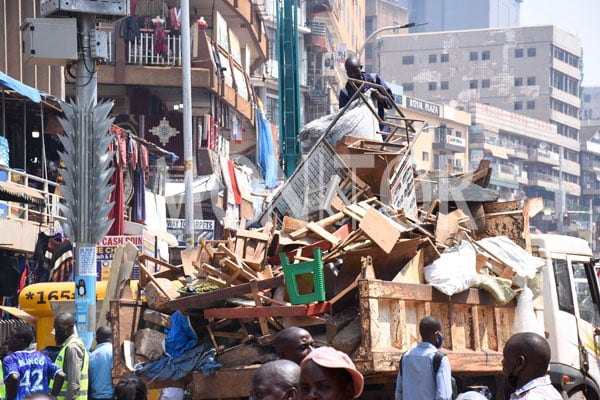
The Kampala Capital City Authority (KCCA) intensified enforcement in the central business district overnight into Friday, 20th February 2026, demolishing dozens of illegal roadside kiosks and structures following the expiry of a two-week ultimatum for traders to vacate streets and road reserves.
City authorities insist the crackdown is backed by sufficient alternative trading spaces, both within Kampala and in surrounding districts, to absorb affected vendors.
KCCA reports that more than 4,000 vacant stalls are available in gazetted markets across Kampala on a first-come, first-served basis. In addition, 1,980 market spaces outside the capital have been secured to accommodate traders displaced by the directive.
Speaking to journalists, Hajjat Sharifah Buzeki, KCCA Executive Director, defended the relocation strategy, dismissing claims that vendors are being displaced without options.
“There is ample market space both inside and outside the city, and this operation is necessary to restore order, safeguard pedestrians, and keep drainage channels unobstructed,” Buzeki said.
The directive, issued on 5th February, called for traders to vacate streets, road reserves, and drainage channels, citing congestion, public health risks, and obstruction of walkways.
KCCA currently manages 17 public markets and oversees 69 privately owned markets, and officials argue that despite repeated calls for voluntary relocation, thousands of stalls remain underutilized.
“Markets have empty spaces, but traders keep operating on road reserves. The problem is not capacity; it is adherence to the rules,” Buzeki added.
However, some vendors say relocating to formal markets poses economic challenges. Traders interviewed in the downtown area expressed concern over reduced foot traffic and potential loss of daily income.
Suliana Nassuna, a vendor affected by the relocation, said her business depends on the heavy foot traffic near taxi stages, and she fears that moving to slower markets would reduce her sales.
“Our customers come to us because we are near busy taxi stages and walkways, and relocating to slower markets risks losing the daily buyers who sustain our business,” Nassuna stated.
Officials, however, argue that illegal roadside structures have worsened flooding during heavy rains, narrowed road space, and increased accident risks, particularly for pedestrians forced onto busy roads.
Buzeki emphasized that the enforcement operation will proceed in phases until full compliance is achieved.
“We cannot allow the city to descend into chaos. Urban order, safety, and proper drainage are non-negotiable,” she emphasized.
The latest operation marks one of KCCA’s most decisive enforcement drives in recent years, highlighting the authority’s renewed push to formalize trade, de-congest Kampala, and test whether market capacity can sustainably absorb thousands of displaced vendors.