

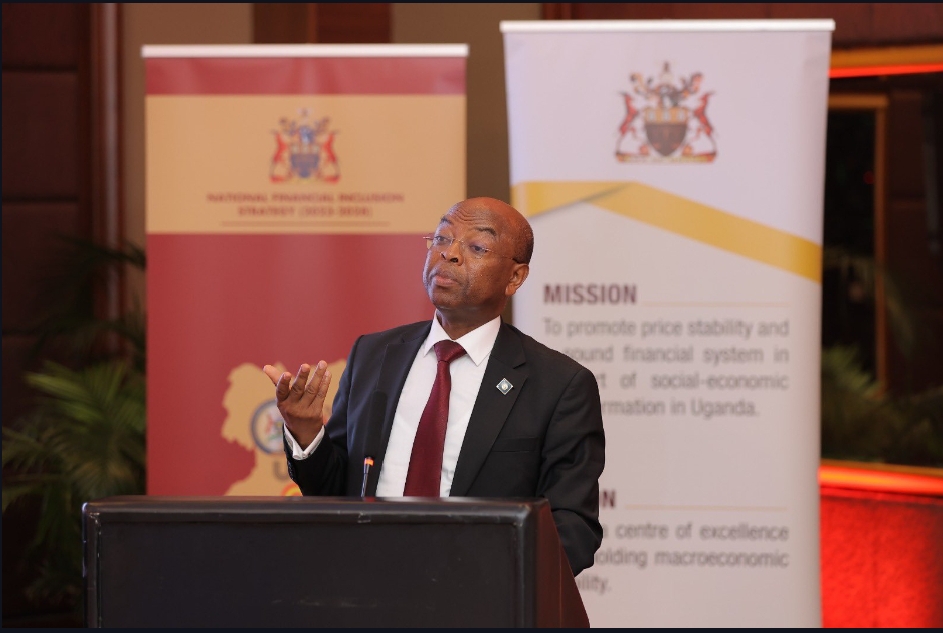
Bank of Uganda (BoU) Deputy Governor Prof Augustus Nuwagaba has said that the global economy is heading into an “interesting” year in 2026, with steady growth expected across major economies and new forces reshaping how countries trade, invest, and produce.
In a statement shared on his X account (@ProfNuwagaba) on Wednesday, January 7th, 2025, Prof Nuwagaba said global economic growth is projected at about 2.8 percent in 2026, calling the outlook a solid despite growing fragmentation in global trade.
“The United States is expected to remain the main engine of global growth. Forecasts place U.S. GDP growth at around 2.6 percent in 2026, supported by tax cuts, looser financial conditions, and a reduced drag from tariffs,” Nuwagaba stated.
According to the outlook, China, the world’s second-largest economy, is projected to grow between 4.5 and 4.8 percent, driven by sustained industrial output and resilient domestic demand.
Europe’s recovery is expected to lag behind other major economies. The Eurozone is forecast to expand by between 1.3 and 1.7 percent, while Germany, the bloc’s largest economy, is projected to grow by about 1.2 percent, largely on the back of government spending and export growth following a prolonged period of stagnation.
Japan is expected to record a moderate rebound, with official projections placing real GDP growth at around 1.3 percent in 2026. This growth is expected to be supported by expansionary fiscal policy, strong global demand for information technology products, and easing energy prices.
Prof Nuwagaba identified artificial intelligence (AI) as a central driver of the next global growth cycle, estimating that global investment in AI could approach $500 billion by 2026.
“Global investment in AI is estimated to approach $500 billion, with 2026 expected to mark a shift from basic tools like chatbots to more advanced “agentic AI” systems capable of reasoning, planning, and executing complex tasks,” he noted.
He added that the rise of centralized AI data infrastructure and deeper integration of AI into global supply chains could significantly reshape production, investment, and business operations worldwide.
However, Nuwagaba warned that the global trade environment is becoming increasingly fragmented, as major economies adopt selective protectionist measures to safeguard domestic industries, signaling the end of an era of rapid, frictionless globalization.
Emerging markets are expected to attract growing investor interest, particularly countries with strong exposure to AI, digital services, and critical minerals essential for new technologies.
Turning to Africa’s outlook, Prof Nuwagaba said the continent’s growth in 2026 is projected to exceed the global average, driven by rapid digital adoption and rising demand for critical minerals.
He cautioned that Africa continues to face significant challenges, including high debt burdens, climate-related shocks, and uncertainty in global trade.
“Unlocking Africa’s full potential will require deep structural reforms, particularly to manage emerging risks such as AI’s impact on labour markets,” he said.
East Africa is projected to lead growth on the continent, though progress is expected to remain uneven across regions, highlighting the need for governments to balance fiscal stability with long-term development priorities.