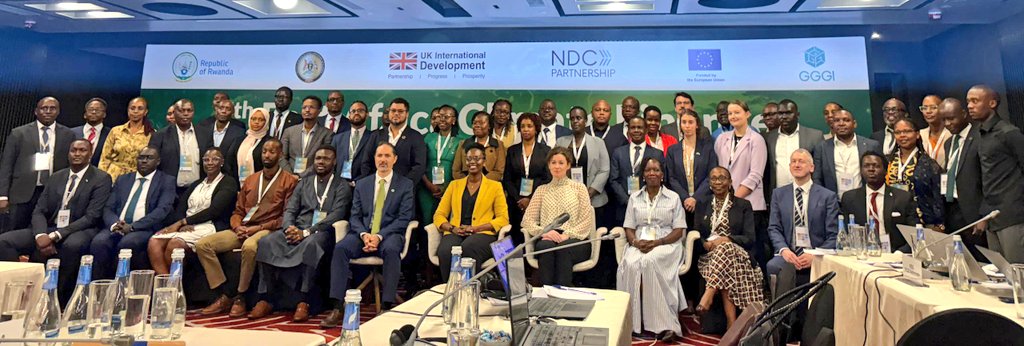
The 7th East Africa Climate Finance Directors’ Level Meeting (EACFDLM) opened in Kigali on Thursday, February 19th, 2026, with a resounding call for bold financial innovation and coordinated regional action to confront mounting climate threats.
Held under the theme, “From Frameworks to Action: Scaling up Climate Finance to Advance NDC 3.0 Ambitions,” the high-level meeting brought together senior finance officials and development partners to chart a path toward mobilizing sustainable climate finance across East Africa.
The meeting was officially opened by Mutesi Rusagara, Rwanda’s Minister of State for Resource Mobilization and Public Investment, who emphasized that climate change must now be treated as a central macroeconomic concern rather than a peripheral environmental issue.
“Climate change is no longer a distant threat but a macroeconomic reality. For finance ministries, climate is not a sectoral issue. It affects fiscal stability, debt sustainability, and the resilience of our growth model,” she stated.
She highlighted that public finance alone cannot bridge the vast funding gaps required for climate action, urging a shift toward innovative blended finance instruments, credible carbon markets, and greater private sector involvement to crowd in commercial capital.
Her remarks set the tone for discussions focused on transforming policy commitments under Nationally Determined Contributions (NDC 3.0) into tangible, bankable investments capable of attracting large-scale funding.
Dr Pablo Martinez, Country Representative for the Global Green Growth Institute (GGGI) in Uganda, Zambia, and Angola, reinforced the need to align ambition with actionable financing strategies.
“Moving from frameworks to action requires not only technical solutions but also coordinated regional commitment,” he noted.
Participants acknowledged the region’s progress in piloting climate-smart initiatives, including electric mobility projects and green innovation programs.
However, they agreed that the primary challenge lies in scaling these initiatives into programmatic investments structured to attract private and commercial capital.
The meeting emphasized the need to transition away from fragmented, project-based approaches toward larger, coordinated regional investment frameworks capable of delivering transformative impact.
As East African countries advance their NDC 3.0 ambitions, the focus remains firmly on translating policy frameworks into measurable, on-the-ground results.