
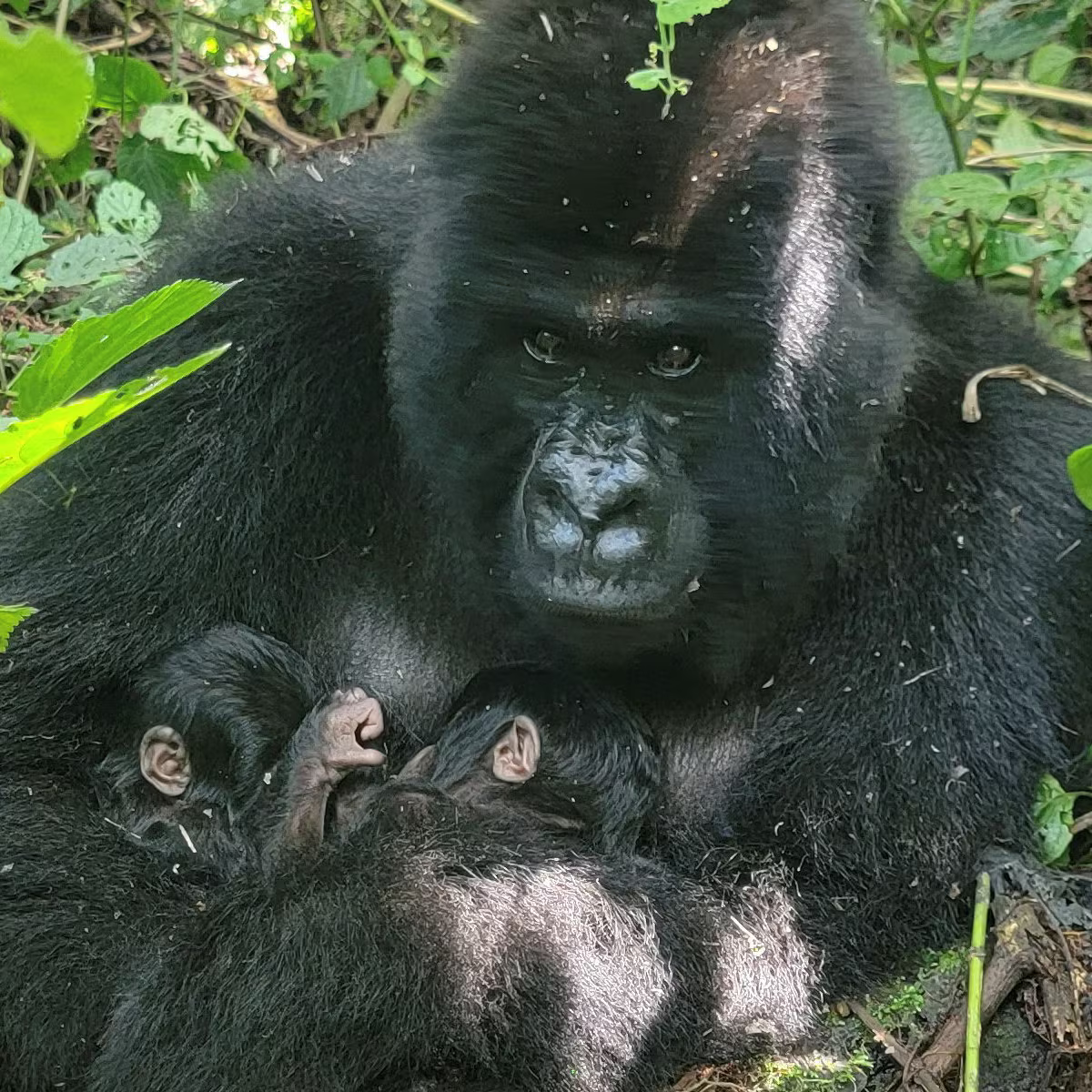
A rare biological miracle has captured the attention of conservationists and scientists in the Democratic Republic of Congo. For the second time this year, twin mountain gorillas have been born in Virunga National Park, a rare occurrence seen among these endangered apes.
The newborns, observed today 24th March 2026 in the Baraka family, are estimated to be about two weeks old and are believed to include one male and one female.
This remarkable birth follows an earlier set of twins born in January 2026 within the Bageni family, showing an extraordinary reproductive event in a species where twin births are extremely rare.
Twin births are rare among mountain gorillas because of the intense demands of maternal care. Typically, a female gives birth to a single infant after an eight-and-a-half-month gestation, investing nearly all her energy in nurturing that one offspring.
Raising twins poses a significantly greater challenge, often reducing the survival chances of one or both infants in the wild.
Conservation experts emphasize that while births are vital for population growth, the successful rearing of twins requires extraordinary maternal effort and resilience.
According to Olivier Mukisya, spokesperson for Virunga National Park, the field teams are closely monitoring the health and behavior of both the twins and their mother.
“These twin births are an extraordinary and rare occurrence among mountain gorillas, so our teams are closely monitoring them to ensure both infants thrive and develop healthily,” Mukisya said.
“The births also offer a rare opportunity for scientific study, especially to understand how gorilla mothers manage the extraordinary demands of raising two infants at once,” she added.
The Baraka family, now 19 members strong, is one of the park’s most studied groups, providing researchers with valuable information about gorilla social structures and reproductive patterns.
With seven births already recorded in Virunga since the start of 2026, scientists are observing not only population growth but also unusual reproductive phenomena such as twin births.
The emergence of two sets of twins in such a short period has piqued scientific curiosity and now researchers are keen to determine whether these events are coincidental or influenced by environmental or biological factors affecting reproduction.
For now, the primary concern remains the survival of the twins. In the dense forests of Virunga, where both natural and human pressures shape life, the successful upbringing of twin gorillas would be an extraordinary achievement.
It would also provide rare insight into the adaptability and resilience of one of the world’s most endangered animals.
As conservationists continue to observe the Baraka twins, these tiny newcomers may reveal new insights into the resilience, adaptability, and social dynamics of mountain gorillas, shedding light on their reproduction and survival, and reminding us of the delicate balance of life in Virunga’s forests.